Week 7 – Chance and Serendipity, Creative Restraint

Do you see chance as a key part photography? To what extent does it play a role in your own practice? How might you develop your work by embracing change or making new opportunities? What arbitrary parameters might you impose upon yourself to expand the creative possibilities of your own work?  

These are all questions asked in this week’s lessons.  In my practice and throughout most of my photographic experiences I would say chance and serendipity have played and continue to play a significant role.  I have always and still do shoot almost exclusively out of doors.  That alone introduces one of the biggest factors of chance, the light.  Is it there, what is its quality, am I in a position to use the light to its best advantage?  Yes, it is possible to preplan and to position oneself where the angle of the light is optimized, and watch the weather forecasts with the hope of getting it right, but in the end whether it all comes together is a matter of chance and beyond the control of the photographer.

When photographing wildlife, there is a great measure of chance and serendipity in play at all times.  Again planning a preparation can improve one’s chances, but in the end it is just a matter of chance whether something, anything, you might want to photograph will show up, and if it does whether it will be in a position that allows a good image to be captured.

I don’t find that I am at all fussed by these elements of chance and serendipity.  I have  always been drawn to the interactions of colour, light and patterns.  It is to an extent, a basic biological phenomenon of vision, but a talent to recognize in a timely manner the significance in any given moment.  For a photographer it is essential to be able to recognize those instances quickly and have the skill with one’s equipment to take advantage of the opportunity.  I believe this to be true whether one is doing street, sports, nature, reportage and likely other genres of which I have yet to think.

The concept of boundaries is an interesting one and deserves thought and discussion.  Art Morris, in his book The Art of Bird Photography and in instructional videos he has done, suggests when photographing birds to confine your field of intention to a 15 degree wedge in front of you with the sun directly behind to get the optimum lighting conditions for good bird photographs.  I find in areas I work frequently that set up is often difficult or impossible to achieve, and that I as a consequence endeavor to cover too broad a field of intention.  I think it might be wise to slow down, be more patient at times and accept that for the truly remarkable photograph, I might need to wait longer for the subject to come to me and the light to be right.  I think sometimes I have succumbed to the desire to get the shot, but as I have become more skilled, I need slow down to a degree and work to get the best shot possible.

I also believe I have been operating principally on the self imposed constraint influenced by so much of the wildlife photography I have seen over the years of creating portraits of birds.  This is true also because I never gave much thought until now of contextualizing my work and only sought to take good photographs as stand alone objects.  Now that I need to consider context, I am beginning to realize there may be other ways to tell a natural history story and the portraiture is only one piece.

MORRIS, A., 2003. The Art of Bird Photography. 1 edn. New York: Amphoto books.
 

Week 5 – Power and Responsibility

In this weeks first forum we were asked to look at the photograph of the refugees crossing into Slovenia from Croatia taken by Jeff Mitchell shortly before the Brexit vote that was used by UKIP in a way totally unintended by the photographer, and to discuss the ethical judgements in relation to the taking of, publication and or use of photographs.  Refugees cross from Croatia into Slovenia in October 2015 (c) Jeff Mitchell/Getty Images https://goo.gl/gtrmU6 (Links to an external site.)Links to an external site.

“Is it fair to depict vulnerable people in a political campaign without their explicit consent? Can the photographer object to the use of the image? What is the purpose of documenting the refugee crisis? And does it incite hatred?

“It is always uncomfortable when an objective news photograph is used to deliver any political message or subjective agenda, however the image in question has been licensed legitimately,” said Getty Images, but did not comment further.” (1)

“The photographic agencies sell the pictures, they never ask what they’ll be used for.

Newspapers use the pictures to make a point according to their political slant.

The photographer’s original intention isn’t even considered.

By adding a few words, Jeff’s intention was changed 180 degrees.

His picture had changed the situation all right.

Just not in the way he intended.” (2)

The Jeff Mitchell photograph reminds of the discussion and comments I made in the first week’s forum on the Global Image.  I doubted then whether an image can truly ever carry universally uniform meaning, and here is an image which in the photographer’s mind intended that outcome, but as the Trott blog above noted, a few words changed the intention completely.  Getty as the intermediary abdicated all responsibility as indicated in the Al Jazeera interview above.

So even the most ethical and responsible among us truly have no control once the rights to our images are released to someone else.  Until we as photographers can somehow imbed in our photographs the intention with which we took them, there will always remain the risk that those images will be misused. Photographs rarely can stand on their own, and the words that go with them matter.  Whomever controls the words can control the message of the photograph.  I suppose if we as photographers wanted to represent ourselves and with each image sold issued a contract with limitation on its use we could mitigate some of the risk, but in reality we would likely end up spending more time in solicitor’s office than on photo shoots.  And the risk would not disappear completely because there will always be the unscrupulous who will seek to improve their own fortunes at the expense of others.

Unfortunately, I believe this is just but one more symptom of a general decline in ethical standards across the globe in which moral responsibility is often seconded to the desires of greed and power.  We are inundated, no bombarded, with images constantly in print media and television trying to sell us something we likely don’t need, but which advertisers are trying to condition us to believe and want.  Economics and power are, and always have been, powerful human motivators.  The most cynical of views would argue since news outlets have grown into profit driven multimedia conglomerates with shareholders to satisfy, the decisions of should we or shouldn’t we publish seem often to made on whether or not it will increase revenue.  Certainly, this is not universally true, but it happens enough to create the situation in which Jeff Mitchell found himself.

Getty used the excuse that they licensed the image legitimately to absolve themselves of responsibility.  Should the licensing agreements be required to reflect the author’s intentions?  Could photographers or agencies survive economically if they did?  Once that photo is in the public domain, is it even remotely possible to control how an image is used?  One needs only to look at Facebook and other social media to see memes created from legitimately licensed images to realize it is probably not.

So for photographers what is the answer?  I think we can only keep taking photographs, do our best to photograph what we feel to be morally and ethically responsible, deal with generally reputable outlets for our work, and hope our work gets used within the bounds of the intentions we had when the image was captured; at least until we can figure out how to bury our captions 3 dimensionally behind or within the image.


SAFDAR, A., , Brexit: UKIP’s ‘unethical’ anti-immigration poster. Available: https://www.aljazeera.com/indepth/features/2016/06/brexit-anti-immigration-ukip-poster-raises-questions-160621112722799.html (Links to an external site.)Links to an external site. [Feb 27, 2018].

TROTT, D., HOW CHANGING THE LOGO CHANGES THE MESSAGE | Dave Trott’s Blog. (11 July 2016)


Week 5 – Ethics and Responsibility: My View


Jade-3505
Jade (Feb 2018)


I was taught long ago that responsibility, accountability and authority (RAA) are inextricably linked.  If I accept responsibility, I therefore must be willing to be held accountable for that responsibility, but only to the extent for which I hold authority.  As a photographer, I have RAA until my image is passed into the hands of someone other than my own.  I may be able to retain some authority over the use of my image through a licensing arrangement, but I will never have any authority over a viewer’s interpretation of my work.

When I have a camera in my hand I am responsible for what or whom, and how I choose to photograph.  I believe I have the responsibility to photograph them honestly, hopefully always objectively, and that I am responsible for their well being in as much as possible during the photograph and after.  As such, I try to not to take images that are embarrassing or demeaning, or in any way make my subject intentionally uncomfortable.  When photographing wildlife, I interpret their tolerance of my presence as consent and an indication they are not disturbed or distressed.  If the species is rare or endangered, I have a responsibility to protect that location so it cannot be exploited.  I am fully accountable to my subjects for my actions, including which images I choose to publish and where I choose to publish.  When granting rights for use of my images, I will take steps to limit, where appropriate and possible, the uses of those images, fully recognizing this is an increasing difficult proposition.

I would like to hope that a publisher would be to an extent responsible to me and my intentions.  I realize in this day and age that is probably a naïve perspective, but I hold hope that there are still many ethical people and organizations in the world.

Week 4 – Evolving

The Face to Face workshops, Symposium, Portfolio Reviews and this week’s collaborative projects have provided more interaction with other photographers than I have ever had before. The talent was extraordinary and caused me at moments to wonder if I belonged among this company and course.  I was astonished by the varying perspectives photographers took in how they approached the same subject, and I was even more surprised at how varied the feedback was on my portfolio of work.  I have to say the emphasis I put in on bird photography was beginning to leave me feeling a bit boxed in  and I am thankful to Paul Clements who, in an informal review in which I also showed him some of my other work, told me to go in what ever direction I wanted and just because my admissions portfolio was wildlife and natural history based it didn’t mean that was what I had to do.  Quite liberating that; and it opened my mind to some other possibilities.

Collaborations during the workshops and this week in the exercises showed again varying perspectives can contribute to an outcome.  But as I got to thinking about photography and the stereotype of it being a solitary experience I began to realize it is never a solitary experience.

“Photography is conventionally understood as a practice engaged in by solo, even solitary, operators. True enough, typically only one eye and finger are responsible for pressing the shutter release. However, photography encompasses much more than button pressing, and many hands are often involved in the broader photographic process of printing, editing and distributing images. The popular image of the photographer as someone working alone — from the intrepid photojournalist to the introverted artist — is therefore something of a fiction.”  (Palmer 2013)

We as photographers are always collaborating.  We collaborate with our equipment.  We collaborate with the light. We collaborate with our subjects.  We collaborate with our consumers and we collaborate with everyone else in between who might be involved with bringing our image to a consumer.  So while the notion of a lone photographer trekking off to a far away place to capture an image is romantic, it belies the degree of collaboration required to bring that image to view.

The project I am proposing to do will require a great deal of collaboration.  It will require a combination of documentary photography, landscape photography and wildlife/ natural history photography to tell the story of the Coul Links project.  It will require me to work with the team developing and constructing the project to stay attuned to their schedules and plans.  It will require some collaboration with outside groups to understand their concerns and objections to the development so that I can if possible record the actual results of the development and its impact on the SSSI site and the species that exist there.

I can sense that I am evolving, and am beginning to better understand the overall objective of this course, and to find my voice.  It finally occurred to me that that if I were doing a Masters programme in Organic Chemistry, I wouldn’t just be doing a set of elegant experiments to demonstrate reactions that were independent of each other.  I would need those experiments to relate to each other in a way that would lead me to a evidentiary conclusion; that is to prove or disprove my hypothesis.  Similarly then, a series of beautiful photographs without a story that binds them together would not answer the question being asked of me as an photographer in pursuit of an MA.


PALMER, D., 2013. A Collaborative Turn in Contemporary Photography? photographies, 6(1), pp. 117-125.


Week 2 – Photography and its Relationship to Other Disciplines

In this week’s activity I chose to briefly explore the questions of time and motion and their relation to photography.  Still photographers images record historical events; i.e. since they are not viewed in real time as they are happening they are consequently historical records.  Physics and specifically astrophysics demonstrates most clearly the time lag in an image’s recording of events. Similarly the physics of light transmission and camera design dictate a the limits of our abilities to create the perception of stopped motion when in fact virtually every subject is actually in motion (if only at the atomic level) that is beyond our level of perception.

NGC 248 in the Small Magellanic Cloud
About this image

NASA’s Hubble Space Telescope captured two festive-looking nebulas, situated so as to appear as one. They reside in the Small Magellanic Cloud, a dwarf galaxy that is a satellite of our Milky Way galaxy. Intense radiation from the brilliant central stars is heating hydrogen in each of the nebulas, causing them to glow red.

The nebulas, together, are called NGC 248. They were discovered in 1834 by the astronomer Sir John Herschel. NGC 248 is about 60 light-years long and 20 light-years wide. It is among a number of glowing hydrogen nebulas in the dwarf satellite galaxy, which is located approximately 200,000 light-years away in the southern constellation Tucana.

The image is part of a study called Small Magellanic Cloud Investigation of Dust and Gas Evolution (SMIDGE). Astronomers are using Hubble to probe the Milky Way satellite to understand how dust is different in galaxies that have a far lower supply of heavy elements needed to create dust. The Small Magellanic Cloud has between a fifth and a tenth of the amount of heavy elements that the Milky Way does. Because it is so close, astronomers can study its dust in great detail, and learn about what dust was like earlier in the history of the universe. “It is important for understanding the history of our own galaxy, too,” explained the study’s principal investigator, Dr. Karin Sandstrom of the University of California, San Diego. Most of the star formation happened earlier in the universe, at a time where there was a much lower percentage of heavy elements than there is now. “Dust is a really critical part of how a galaxy works, how it forms stars,” said Sandstrom.

The data used in this image were taken with Hubble’s Advanced Camera for Surveys in September 2015.

Credits

NASA, ESA, STScI, K. Sandstrom (University of California, San Diego), and the SMIDGE team

While this image relates to my practice in the general sense that is scientific, it is of course in a completely different field of science.  I chose this image because it made me think about the points raised in the presentations, specifically about the relationship of time and motion, history and current affairs.  This image, and any of the thousands of others taken by the Hubble Telescope are particularly intriguing I think because while they have all been recorded and published contemporaneously they are in fact images of extraordinarily old events.  This image for instance records not what NGC 248 looks like today, but rather what it looked like 200,000 light years ago.  So it is the extreme example illustrating that all still photos are at the same time contemporaneous and historical.  We are much closer to our subjects even with the longest telephoto lenses, but the principle applies in that we recorded something that happened a split second ago transmitted to our camera sensors or film by reflected light moving at 186,000 miles per second or almost 671 million miles per hour. For the time our shutters are open we are in fact capturing a composite image of all that occurred in that time.  We perceive we have stopped action at 1/500, but we just can’t perceive the motion that occurred in most cases.  For an example that relates to my practice, the photo below of the hummingbird illustrates the point that even though taken at a very high shutter speed able to stop the perceived motion of the bird’s position, the wings beating at about 80 beats per second appear as a blur.
  • Image result for hummingbird photo
One could argue philosophically, that every still photo captures not just one moment in time, but moments in time as represented by the speed of the photons that create our image relative to the time the shutter was open.  I often shoot multiple images at high speed in order to capture a particular movement.  When reviewed quickly they are identical to viewing single frames in sequence of a motion picture and are reminiscent of the little “flip books” we probably all saw or created as children.  So while a carefully planned and staged studio portrait may seem to unrelated to a video, the distinction is blurred considerably in wildlife or sports action photography.

For the week’s Webinar we were asked to discuss how our practices related to other disciplines.  As primarily a wildlife and nature photographer, my practice is rather inextricably linked to Biology and its sub-disciplines, but also relates to Environmental Science, and I aspire to have my images have artistic value. Here are some of my images and my thoughts on how they relate to other disciplines.
Intimate, close up portraits of animals has distinct value in the fields of Taxonomy and Morphology.  That is what are they and what are their characteristics. The Carolina Wren on the left and Red Shouldered Hawk on the right illustrate the point well.  Aside from the obvious of being able to identify the species, their morphology tells us much about the species.  The bill of the wren is slender and adapted to eating insects while the bill of the hawk is much more powerful in its construction and adapted to tearing the flesh from its prey.  Similarly the powerful talons of the hawk and shear size show how it is able to grab and hold prey while the diminutive feet on the wren are useful only to moving along the ground and perching on branches of trees.
Photos of species within their habitat are useful in the field of Ecology and tell us something about the environments species require to survive. The Kittiwakes on the left are nesting in the sea cliffs of Handa Island in NW Scotland, while the Puffin on the left burrows in the ground at the top of the stacks at  Handa Island.
Photographs showing species feeding give Ecologists and Physiologists important information on what the eat and how they feed and in that how and why those species live in particular habitats and what other species within those habitats are required to support their existence.  The Little Grebe on the left was photographed in Loch Fleet in NE Scotland eating a fish, and the Red Headed Woodpecker on the right is shown pulling an insect larva from the trunk of a snag located in a wetland in South Carolina in the U.S.
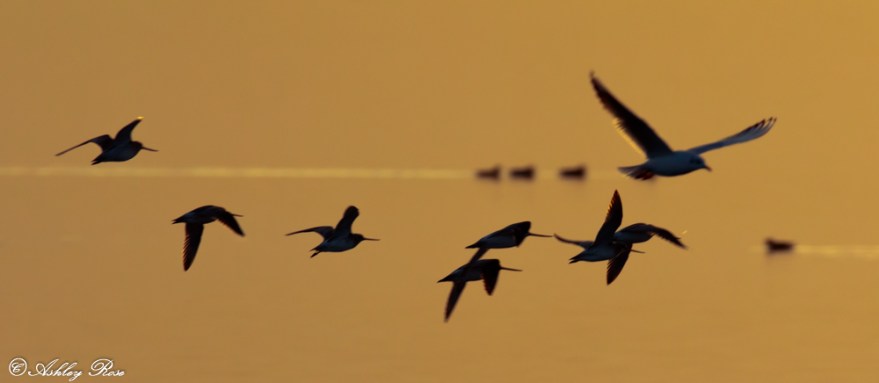
Sometimes a wildlife or nature image has value as a piece of art; simply a beautiful image in its own right and nothing more.  The flock of Godwits passing a Herring Gull while the Widgeon in the background leave wakes that reflect in the evening sun on the Dornoch Firth in NE Scotland.
Godwits, Gull and Widgeon sunset-1849

Week Two- Interdisciplinarity

For the week’s forum discussion we were asked find a piece of work other than a photograph that had some kind of link to our own practice or research interests, and explain why we chose it and how it relates to our own work.  I chose the items below because the relate closely to my interests and the direction I wish to pursue in my research, while at the same time serving as a bit of inspiration and explanation of why I am part of this programme.

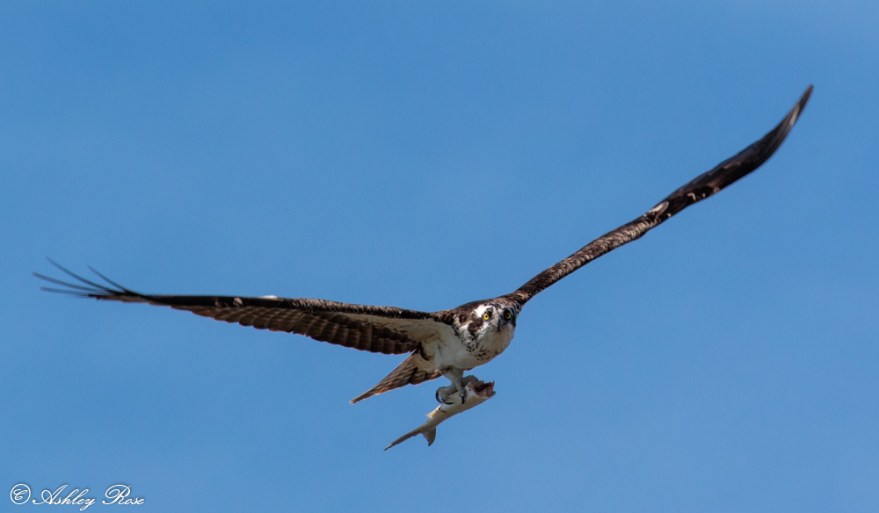
Osprey with a Fish-2368
Osprey


The following paragraphs were excepted from a 19 Dec 2017 article in the online magazine Good Nature Travel; The Official Travel Blog of Natural Habitat Adventures and the WWF written by Candice Gaukel Andrews.  In it she quotes author Terry Tempest Williams 2012 book  When Women Were Birds: Fifty-Four Variations on Voice.

http://goodnature.nathab.com/bird-years-and-the-year-of-the-bird-2018/

We are all birds

In her 2012 book When Women Were Birds: Fifty-Four Variations on Voice, author and environmental activist Terry Tempest Williams wrote, “Once upon a time, when women were birds, there was the simple understanding that to sing at dawn and to sing at dusk was to heal the world through joy. The birds still remember what we have forgotten, that the world is meant to be celebrated.”

So while our birds still sing, I hope we will all join in the celebration of 2018 as the Year of the Bird. But, while we’re doing that, let’s remember that those tuneful voices that lift us in our darkest hours are the ones that we humans are actively working to silence once again, possibly for forever.

Here’s to finding your true places and natural habitats,

Candy

Terry Tempest Williams in the same book also wrote the following:

“To be read.  To be heard. To be seen. I want to be read.  I want to be heard.  I don’t need to be seen.  To write requires an ego, a belief that what you say matters.  Writing also requires an aching curiosity leading you to discover, uncover, what is gnawing at your bones.  Words have a weight to them.  How you chose to present them and to whom is a matter of style and choice.”

The follow is excepted from 15 Dec 2017 article, How Birds Bind Us, in the Audubon Society online magazine by Mark Jannot. http://www.audubon.org/news/how-birds-bind-us

The way the artists and the entire community in upper Harlem have come together around the murals (and have spread the word about the threats to birds) has been inspiring, but it really shouldn’t be seen as surprising. Not, at this point, to me anyway. In the nearly five years I’ve served as the editor-in-chief of Audubon, I’ve seen a zillion amazing and wide-ranging examples of people coming together and rallying around birds, from volunteers with New York City Audubon monitoring (and, when necessary, shutting down) the memorial 9/11 spotlights to save migrating birds, to people recreating habitats and even entire islands for their benefit, to using them as aids for bringing struggling veterans back from the brink.

I find great pleasure in birds; observing them, listening to them and photographing them.  Their presence reassures me that things are right in my little piece of the world at that moment in time.  Birds are present across the globe from pole to pole and everywhere in between.  Some have adapted to the harshest places on the planet while others have found a way to live in close proximity to humans in the most urbanized and industrialized places on Earth.  Yet for many humans, birds are nearly invisible.  There are 574 recognized species in the UK (RSPB) and 810 in North America (Sibley), and I would venture most people would not recognize more than a few species.

2018 is the 100th anniversary of the Migratory Bird Treaty Act and 2018 has been designated by National Geographic and the Audubon Society as the Year of the Bird.  Birds are a bellwether of our environment. Thomas Lovejoy, Biologist and founder of the idea of Biodiversity said “If you take care of the birds, you take care of most of the environmental problems of the world.”  Recent legislative changes in the US have served to once again put birds at risk, and the unchecked impacts of plastic pollution and climate change caused by humans is putting additional stress on bird populations.  Audubon research indicates 314 species are endangered due to climate change alone.

The focus of my work is intertwined with biology (ornithology specifically), ecology and the environment, and could conceivably contribute to discourse on the importance of preserving biodiversity and the impacts of human actions on it.  For me this represents a closing of the circle that began with my secondary school and undergraduate work as a biologist and ornithologist. 

Mrs. Williams paragraph about writers can equally apply to photographers.  Photos also carry weight and great photographers share that same aching desire for discovery with writers.  I am in this course in large measure to find my voice as a photographer, and to find a way to have my work merit being seen and “heard”, to matter.  Birds are still singing, but I fear too many people are not listening. I hope in finding my photographers voice, I will be able to use it to get a few more people to listen.

I grew up wanting to fly and I have had the privilege (albeit with some mechanical assistance) to experience the freedom of flight; to dive, to soar, to dance among the clouds and race across the treetops.  I have been a bird and wish everyone could know that joy.


The Global Image: My Perspective

I wrote the first post after watching and reading the module presentations from notes I made, but before I had read the Talis Reading list material.  Having now finished those I find my initial notions largely reinforced and am drawn to the conclusion that it is highly unlikely there is such a thing as a true “Global Image.”  While some photographs may have broader and therefore more global appeal than others is undeniable, but to paraphrase P.T. Barnum;  you can please some of the people some of the time, but you can not please all of the people all of the time.

I have the luxury in some regards of having 64 + years of life experience, and while as 20 ungraduated student I found it difficult to form and articulate my own opinions, I find no such difficulty now.  My diverse experiences as a scientist and biologist by education, a career Naval Officer and Naval Aviator by opportunity, an Aerospace Engineer and Program Manager almost by accident, a management consultant by choice, a world ranked internationally competitive amateur golfer by determination and love of the game, and lifelong passionate photographer by avocation have taught me many lessons.

Among the most important of those lessons is that there are very few absolutes in this world, and that the proper answer to nearly every question (certainly those questions of any weight) is “it depends.”  What does this have to do with “The Global Image” and my photography practice?  It seems to me while a photographer may have had an intention in capturing an image, it is quite possible those intentions may be missed in part or entirely by the consumers of the image and people in the middle of the consumption chain can entirely distort the original intention simply by where and how the image is published and around what it is portrayed. Once images leave our hands, we as photographers have little control over how they will viewed.  And so, it seems that the idea of a global image “depends” not only on the subject and the way in which it was captured, but in who is looking at it and where it is being viewed.  So as not to put too fine a point on it I offer an example in the extreme.  A photo of the internees of the Nazi Death Camps would be viewed as evidence of a horrific injustice and time in history by most people who possess even a modest amount of humanity.  However, put that identical photo on the wall of a White Nationalist meeting house and it likely is celebrated and viewed as evidence of a great period of dominance to which they would like to return.  Thus we find ourselves at the precipice of the proverbial slippery slope when we try to make objective judgements on a topic that is largely subjective.  Beauty or ugliness is ultimately inn the eye of the beholder.

What does this do to inform my own practice?  It is of course early days and I reserve the right to change my opinion as time goes on and I continue to learn more about myself and my craft as a photographer.  Nevertheless, I believe it will require that I approach my practice as I have come to approach the other aspects of my life.  I intend to pursue my practice, as much as possible, with kindness, consideration, compassion, and honesty about and for my subjects and my surroundings, and perhaps most importantly, that the results of my work please me technically and aesthetically.  If I am able to achieve these things I will consider my work a success, and if it happens that others derive some pleasure or useful information from my work it will be a bonus.

The Global Image

The following questions were posed at the end of the introductory presentation:

Do you see any parallels between the historic spread of photography and the transmission of digital imagery today ?  Can you think of any problems associated with the speed at which the photograph moves?

The French government’s licensing of the Daguerre Type, which facilitated its spread around the world, is somewhat analogous to the spread of mobile phones today.  Photography has become truly ubiquitous and virtually everyone in the world is a producer and consumer of photographic images.  We are inherently a visual species and, therefore, perhaps quite inclined to accept images not created by our own eyes as credible substitutes.  The internet, television and other mobile technologies which have proliferated around the world in a seemingly ever increasing pace provide a non-stop stream of visual imagery to all corners of the planet.

So while we may be inclined as a species to “believe” what our eyes see, the facts are not all photographic images tell the truth or at least the whole truth.  A snapshot of a mere fraction of a second may have no context or can be easily taken out of proper context, and can lead to grossly misleading conclusions.  Add to the modern dilemma our ability to digitally manipulate a photographic image and one could call into question the veracity of any photograph.  Like any technology, photography carries with it a spectrum of uses and abuses.  As consumers, we are called upon to be ever more discriminating under the onslaught of constant imagery, not all of which is being produced responsibly or ethically.  It is a powerful medium and perhaps more powerful now than it has ever been because of the speed and reach that digital transmission has permitted.