
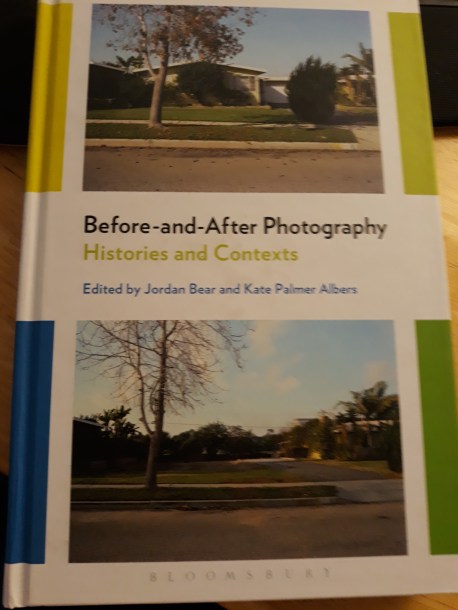
I just finished reading most of this book and found it quite thought provoking. There seems a great muddle even amongst the “experts” in the epistemology and ontology of photographic practise that includes more than one photograph taken of the same subject. Is it “before and after”, rephotography, repeat photography, a series, or “then-and-now” photography? Depending on which source one might choose to use, it could be any one, all, or none of these labels.
Albers and Bear write in their opening chapter:
“Among the most significant orthodoxies in the recent historiography of photography is a shared conviction that a single, authoritative account of the medium is both impossible and undesirable. A tenet of much of the most innovative scholarship since the 1970’s, this commitment to a plurality of histories is summed up in the scholar John Tagg’s haunting disavowal: “Photography as such has no identity…its history has no unity. It is a flickering across a field of institutional spaces. It is this field we must study, not photography itself”
And precisely because of photography’s lack of identity outside of specific discursive and institutional contexts, the art historian, the climatologist and the sociologist have no common idiom for discussing their photographic research.
As such, we focus on before-and-after photographs as a strategy so commonplace that virtually every disparate photographic discourse has enlisted it.”
It seems to me the ubiquity of photography and its employment across virtually every social, scientific and artistic discipline renders photography in some ways a tool of the discipline in which it is being employed rather than an end unto itself. I think this is the point Tagg was trying to make and the argument Bear and Albers put forth that there may be strategies employed across those disciplines that provide a basis for a common framework. However, the distinctions they make between the related tropes that share in common the employment of more than one photograph are less than clear cut as evidenced by the essays that comprise the remainder of the book.
In the afterword, James Elkins writes:
“Because I am not sure how to distinguish rephotography from before-and-after photography, or before-and-after photography from individual photographs, I prefer to think of those odd experiences as extreme cases of the sorts of seeing that are provoked, unexpectedly and in general, by photographs of many kinds. If seeing photographs involves self-indulgent, myopic, or even anascopic seeing, and if it elicits subjunctive, reparative mediations on what was, what came between, and what came after, then before-and-after photography may be more an extreme kind of photography, a limit or test case, than a separable genre or mode or practise. It may be a kind of photography that helps us to understand what some photography can be.”
Bear and Albers try to distinguish before-and-after photography as two photos punctuated by a singular unseen event that causes the change observed in the photographs, and which requires the viewer to imagine the nature of that event. Rephotography, such as practised by Mark Klett and others, is likewise two photographs temporarily separated by an undefined period of time in which the viewer is still required to discern the changes and imagine what cause or causes effected the changes. Both before-and-after photography begin from a single photograph and often with no intent to necessarily take a second photograph of the same place in a different time. Occasionally, one might have foreknowledge of an impending event that would lend itself to a before-and-after trope. The only way I can distinguish then-and-now photography from rephotography in either method or intent is rephotography necessitates taking the photos from the same place with as close as possible replication of the original perspectives. Jem Southam’s work The Painter’s Pool is more of a then and now piece of work giving a feel of a place over a period of time without trying to recreate an original photograph.
Repeat photography, on the other hand, begins with intent to observe changes in a place over time by taking two or more photographs from the same place over some again undefined span of time. It begins also with a belief that observable changes will occur by known or unknown single or multiple causal factors. And herein comes the rub.
If I know that a hurricane is about to hit or a volcano about to erupt and I take photographs of the area to be affected by the event with the intent to return and photograph the aftermath, am I engaging in before-and-after or repeat photography? Does it matter? If I stay and take photographs during the event it is no longer unseen and therefore does not fit the definition of before-and-after photography, but is it repeat photography with a relatively short temporal displacement or is it a series? Again, does it matter? If I take a series of photographs that captures the full sequence of an event, but then choose to only show the first and last in the series and leave the event unseen, is that before-and-after photography, or have I just made an editorial or curatorial choice?
Aren’t all of these distinctions somewhat arbitrary and vague? Are they not in fact a continuum of sorts with boundaries that overlap as a function in part of the epistemological perspective of the project? Perhaps what matters is that all the photographs provide some level of information imbued by the apparatus and the choices of the photographer that remain to be decoded by the viewer. Furthermore, what seems common among virtually all of the examples described in the book, regardless of which trope one might assign, is none seem be approached by the photographers with an agenda, and rather are largely indexical in character. The assignment or interpretation of significance seems to come in part from the editorial and curatorial choices made by the photographer, and from the viewer and whatever perspectives and biases they bring to viewing.
What relevance does this have to my project? I am in large part observing a place over time. I entered the project with the idea this was a classic repeat photography project in which I would observe and record both natural and anthropogenic changes on a landscape over a period of approximately two years. However, I have foreknowledge that a major anthropogenic event will occur that will cause dramatic changes in the landscape. Has this become a before-and-after project or because I will photograph the changes as the event occurs does it become a series? Does the trope to which it is assigned depend on what and how I choose to show the results? Can it be everything and none of these things depending on those choices? And, does it matter? Can it not just be what it is? Can I not just use photography as epistemological and ontological tool to understand my world?
I think I can.
Tagg, J. (1988). The Burden of Representation: Essays on Photographies and Histories. Minneapolis: University of Minnesota Press.
Bear, J., & Albers, K. P. (2017). Before-and-After Photography; Histories and Contexts (1st ed.). London; New York: Bloomsbury Academic.
 Ashley Rose Photography Journal