Week 4 – Hands Off

The week’s presentations centered around strategies that are outside the conventional approaches to photography; at least the ones that I use in my practise.  I am not comfortable in general using work I have not created so I found many of the strategies discussed this week quite strange.  Although I have to admit projects such as Jenny Odell’s Travel by Approximation were extremely innovative and clever.

The week’s work has certainly challenged some of my well ingrained notions of what photography is and can be.  The idea of not using a camera was particularly difficult to embrace, especially when trying to find a way to relate it to my project. But that was the crux of this week’s activity.

This task asks you to reconsider your relationship with your preferred apparatus by NOT using it.  You have 24 hours to produce a mini-series of five images relating to your research project, without using apparatus that is familiar to you.  All images must be produced on Wednesday 27th June between 00:00am and 23:59 (local time).  Understandably, many of you will have other commitments during this period. If so, you are encouraged to see these as a challenge and incorporate them into the task somehow. After all, it is possible to be a lot less conspicuous without a camera.

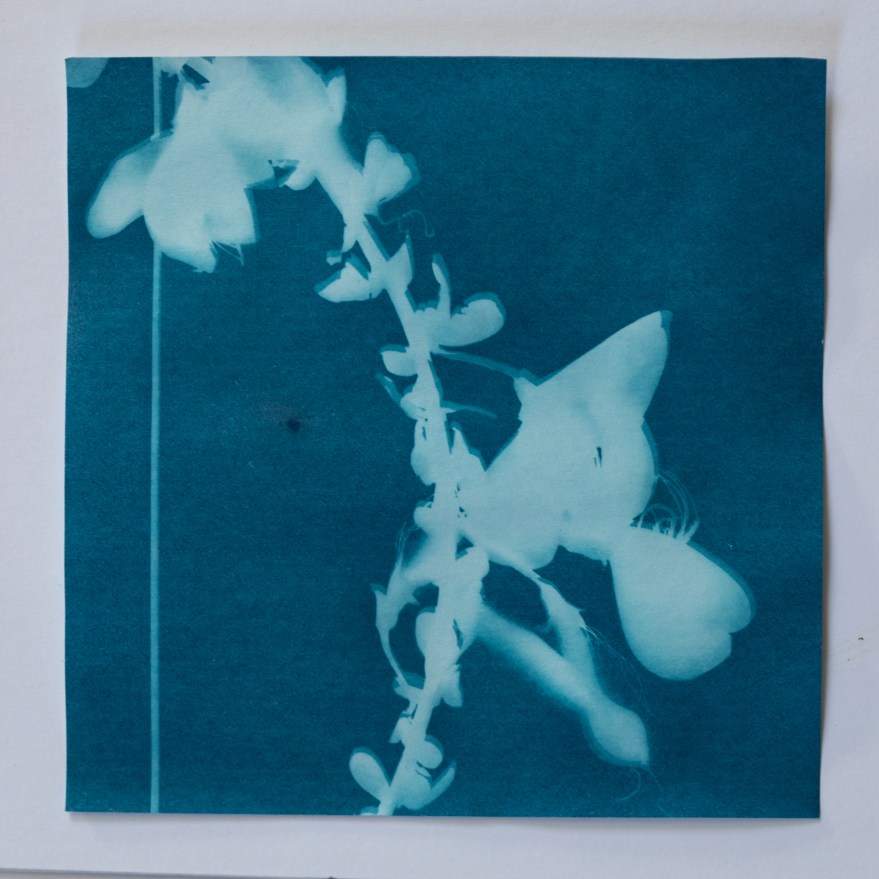
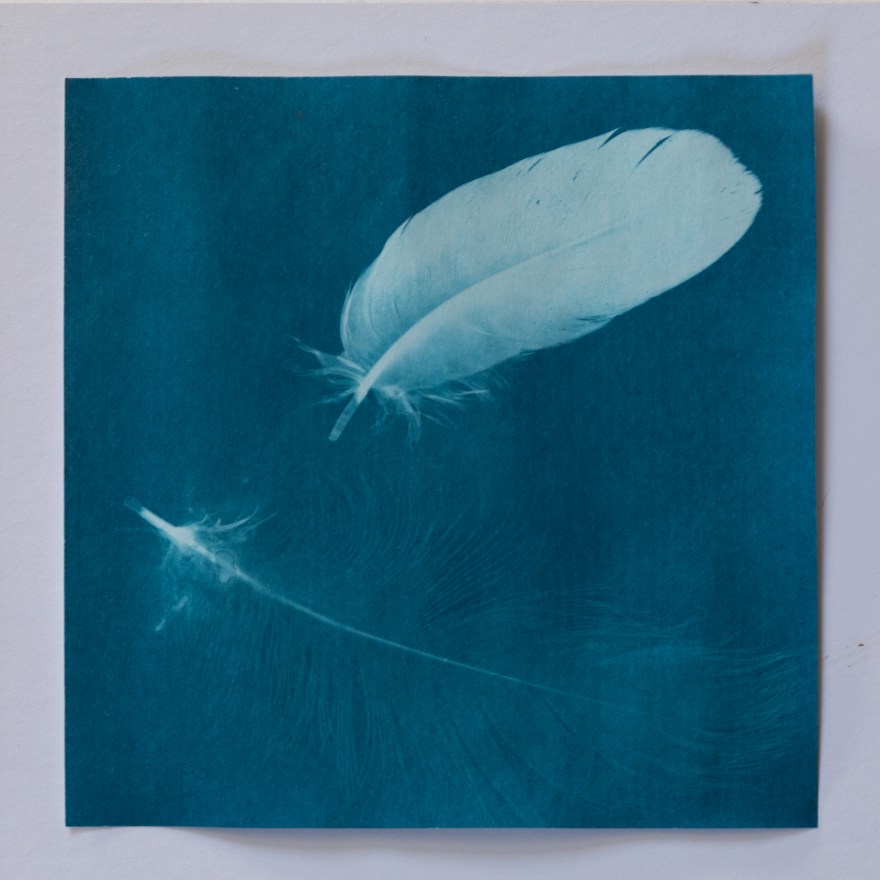
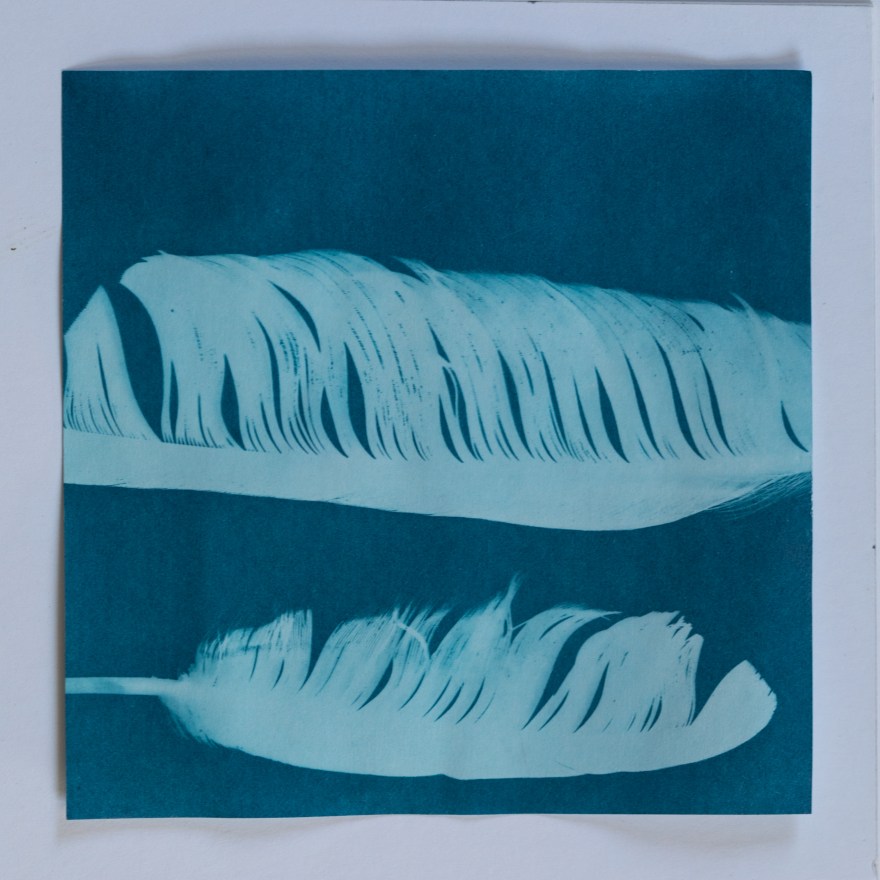
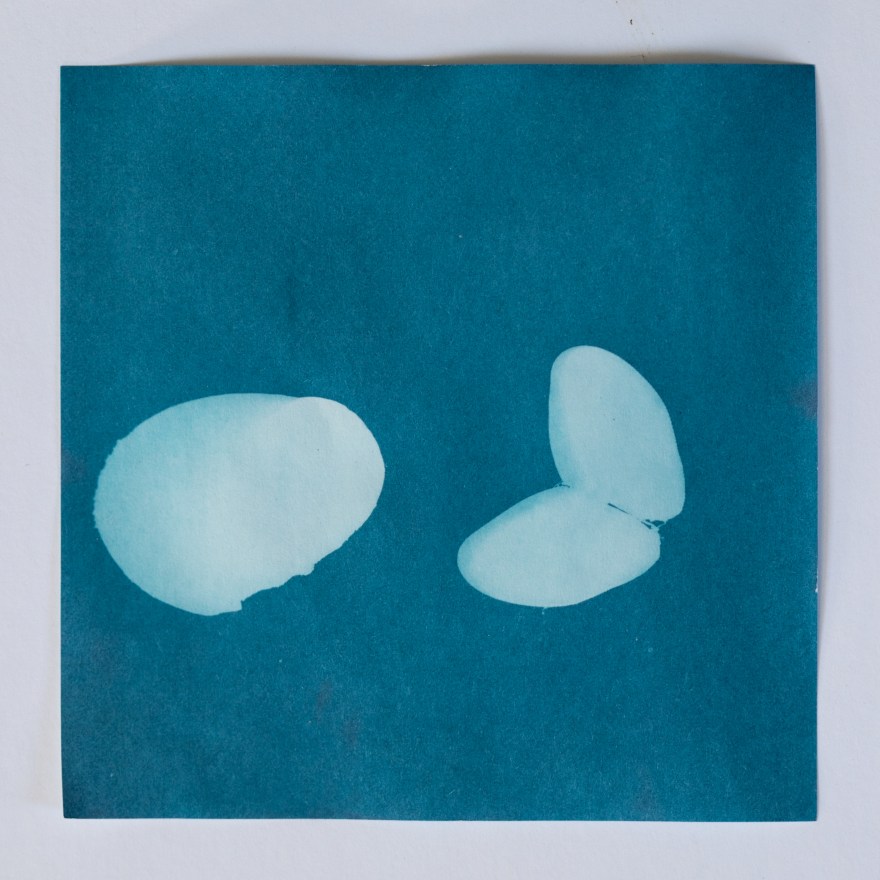
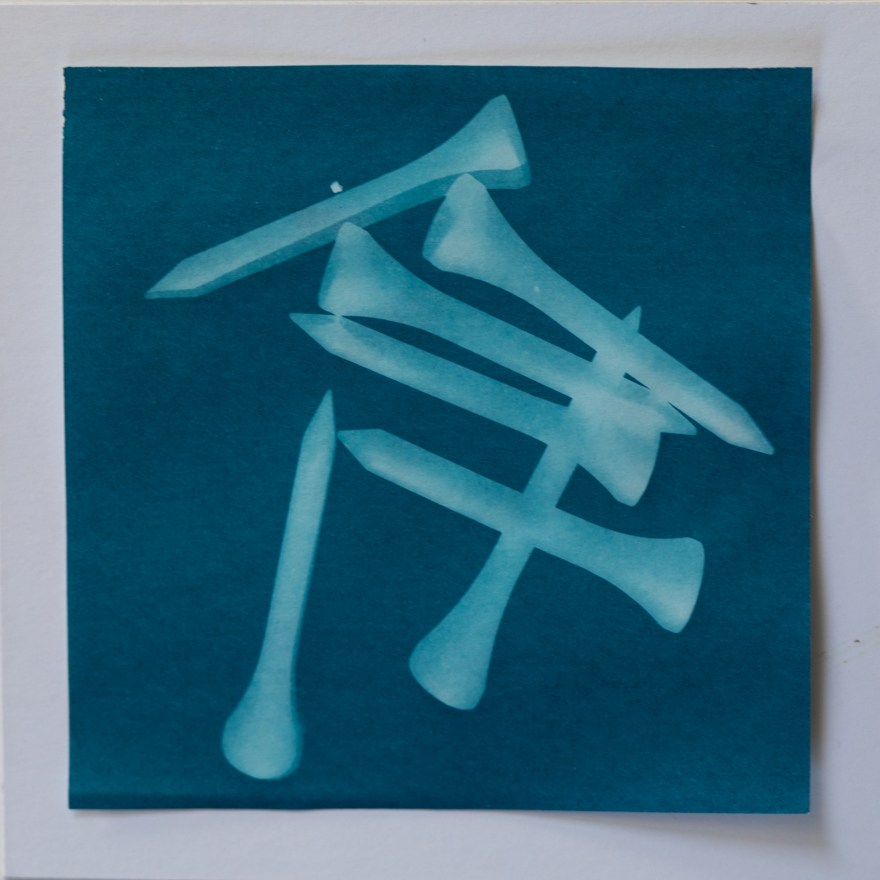
I thought about using my mobile phone camera because for the type of photography I do it is not a preferred apparatus, but it is one with which I am familiar.  I don’t have access to 35mm film or medium format cameras here.  Google Earth has satellite views of my project area which I have already used, and there are other photos on the web of Coul Links taken by developers and eco-tourists, but not much that seemed interesting to co-opt.  So in the end I decided to try using cyanotype paper using a Sunprint kit I obtained through Amazon.  I collected bits of plants feathers and shells and made a series of prints.  I also made one using golf tees as a symbol of what is likely to happen on the site.  Here are the results.
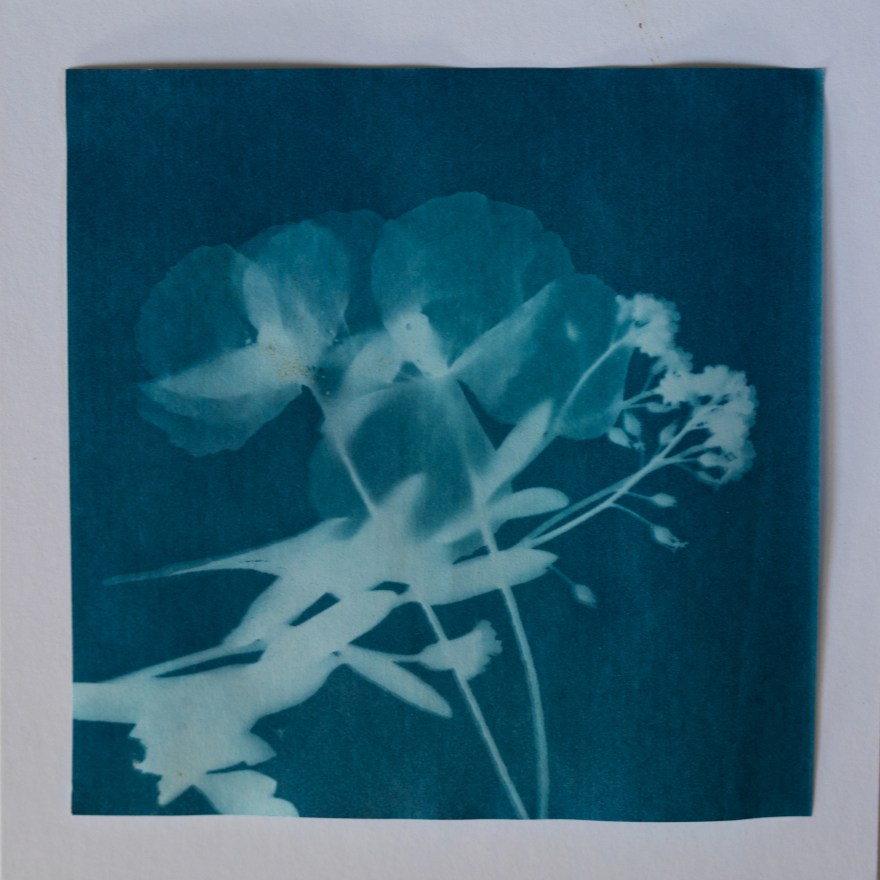
Wildflowers-7233
Wildflowers
Broom Flowers and Leaves-7248
Broom Blossoms and Leaves
Feathers-7241
Feathers
Feathers-7244
Feathers
Gastropod and Bivalve Mollusc Shells-7230
Gastropod and Bivalve Mollusc Shells
Golf Tees-7238
Golf Tees


While I didn’t find this exercise particularly useful in terms of applicability to my project, I did rather enjoy to process of creating these images.  First, trying to figure out what I might be able to accomplish with what I could get my hands on on short notice, and that had some relevance to my project was interesting and challenging, and forced me to look at possibilities I would have never otherwise considered.  Second, once deciding to do the cyanotypes, what materials could I find that would lend themselves to this particular media and could I compose them in an aesthetically pleasing way?  And lastly, the process of exposing the image itself yielded pleasantly surprising results.  The sun was quite strong and the exposures were about 1 1/2 minutes.  I was particularly surprised at the dimensionality of the golf tees and the delicacy of the feather images.  The texture in the wildflower print caused by the relative difference in transparency between the wild poppy and the other flower was another surprise.  So while I cannot see a practical use for this particular strategy and surface in my project, that is not to say there is not a place for something like this in another project someday.  And if it is not this surface, I have been awakened to the fact there are other ways than a DSLR to create images.


Week 3 – Making a Zine, Collaboratively

Among this week’s tasks was an assignment to form a group, crowdsource images and create a Zine.  I must admit to not really knowing what a Zine was before this so of course I was the perfect choice to lead our group.  The group of seven came together quickly and coalesced around one of the two ideas I proposed.  With Father’s Day being last Sunday we collectively agreed it was a timely topic and that we would ask people to take a photograph of something or someplace that evoked a memory of their father and then to write a few words on why that particular image was significant.  While everyone liked and embraced the concept we chose, I think to a person we were all pleasantly surprised by the response we received and moved by many of the images and stories.  There was something powerful in the combination of the images and their accompanying stories; something unique in each, but relatable to all.

We in total received close to 50 submissions, many of which were very poignant, some whimsical, some happy and some sad.  We each posted the photos and stories we received to our space on Canvas, and then had a group webinar to curate the collection and agree on what format we liked for the Zine as well as making assignments to complete the production.

The group worked very well together throughout the process and we were able to use both the Canvas discussion space and a WhatsApp thread to discuss progress, communicate assignments and decisions contributing to the efficiency in which we were able to complete the assignment.  While the old adage of “too many cooks spoil the broth” could come in to play in a collaborative effort, it was not the case here.  A few of the group had produced Zines or at least experienced Zines before and that was helpful in assembling and publishing the final product.  Everyone of our group participated, cooperated, and collaborated to collectively create our Zine, the link to which is below.

Dad. A Curated Look at Fathers – FINAL – PRINT RESOLUTION

How does this relate to my practice and what can I take away from this exercise that might influence my practice in the future?

My practice has historically been rather solitary and since I rarely photograph people, quite absent collaboration other than with my husband who often accompanies me on shoots and assists me in carrying kit and ensuring we do things safely.  Many of my thousands of photographs were never seen by anyone but a few close friends or family.  So it is only relatively recently as I make my work more public and contextual that I have come to appreciate that while I may not collaborate much in the making of my images, there is value in having others involved in the process of getting my images into public view.

My years in the corporate and consulting worlds taught me the value of “cold eyes” reviews as we are often too close to what we create to be able to understand how someone seeing something for the first time might see it.  It is difficult to be completely objective about something we create and we often see what we want to see, or what we thought we were creating.  The more familiar we are with a subject the more likely we are to have made assumptions and logical leaps that are not possible for someone coming to the topic for the first time.  I valued the varying perspectives of my colleagues during the Zine exercise and have also on other bits of work in this course.  The range of experience and the range of perspectives born out of their respective practice specialties has proven interesting, educational, and useful in helping me understand what other people see (or don’t see) in work I have created.

Furthermore, I really enjoyed working with others and as my practice matures, I will look for ways to do more of that in the future.  A couple of my projects are going to involve a lot more coordination and planning and therefore collaboration in order to achieve the end result.  I look forward to it.

I also am glad to have introduced to the Zine concept.  In many ways Ed Ruscha’s 26 Gas Stations was a Zine; soft cover, inexpensively produced on less than high quality medium.  I can see a possibility of using the Zine approach in the future for my work, either as an advertisement for my work or as an end product.  My eyes continue to open to the expanse of possibilities available to me.

Week 2 – Project Trailer

As part of the week’s activities we were to create a video “teaser” trailer about our project according to the following instructions.

“Making a trailer may initially seem an unusual activity in a photography course, but trailers have become a useful tool for blockbuster exhibitions in recent years, with varying approaches and budgets. Furthermore, making a trailer is a great way to step outside your comfort zone and refine your sense of storytelling, as well as being a good way to explore the fundamental time-based relationship between images and words.  Think about which images of yours (or others’) can help express / reveal key parts of your project. Think about how to get your audience interested in the images, how to build tension (or not) and how to release that tension.”

Suffice to say this task did push up against the boundaries of my comfort zone, but not as severely as creating the Positions and Practice Oral Presentation.  Having scaled the steepest part of the learning curve then made this time seem much less overwhelming.  During P&P, I tried to use Adobe Premier, but just couldn’t seem to make it do what I wanted it to do in the time frame I had  for the OP.  I ended up using PowerPoint and converting the presentation to video, but I did gain a bit of experience with Premier that made jumping back in for this exercise much less about “which buttons control which functions?” and more about turning a concept into a reality that met the brief within the prescribed limit of 2 minutes.

It also is clear that I am becoming more comfortable with the idea of using my images to tell a story; an aspect of my photographic practice that was always noticeably absent.  There has in fact been a distinct shift in the approach to my practice and while I will still  photograph something because it appeals to my eye, the majority of my work now is far more purposeful.  I start a shoot with a much clearer intention and sense of what I will need to tell the story I have in mind.

The result was successful overall, though I wish I could have gone a wee bit longer to allow for a better ending on a natural break in the music track.  I believe I used images and music to convey a dramatic tension and the overall sense of the project.  The result can be viewed in the link below using the password Falmouth.

Week 2 – Appropriation and Context

This week’s forum was a discussion centered around the controversy over “The Rights of the Molotov Man” and the case known as Joywar.  In 2003 Joy Garnett used an image taken in 1979 by Susan Meiselas of a Sandanista rebel in Nicaragua as inspiration for a painting in a collection called Riot.  Garnett did not acknowledge the original author which was in my opinion an ethical breach.  While Meiselas claimed copyright infringement, Garnett in fact created a unique, derivative work based on Meiselas’ photo.  Meiselas later stated her principal objection was the loss of context of the original photo and the appropriation of its subject for a different purpose.

Sontag wrote “To photograph is to appropriate the thing photographed.” (Sontag, 1977) She goes on further to say “The photograph a thin slice of space as well as time.” “Anything can be separated, can be made discontinuous, from anything else, all that is necessary is to frame the subject differently.” “Any photograph has multiple meanings: indeed, to see something in the form of a photograph is to encounter a potential object of fascination.” “Photographs, which cannot by themselves explain anything, are inexhaustible invitations to deduction, speculation and fantasy.” (Sontag, 1977)

While Garnett should have acknowledged Meiselas’ photo as her inspiration, I find Meiselas’ argument about Garnett having stolen the context of the original photo to be specious and frivolous.  Someone standing next to Meiselas taking a photo of the same original event might have had a very different interpretation of the event if they had been on the other side politically and may have seen a riot instead of a rebellion.  As soon as a photo is published its author’s context is lost to that of the viewer.  Garnett simply chose to accept the invitation to deduce, speculate and fantasize about the image to create her new version.  I can see Meiselas’ point about the subject, Pablo Arauz, having his story misappropriated as he had a specific history, a piece of which that was captured in Meiselas’ photo, but that image was also appropriated by the Sandanista government and showed up on walls and matchbooks with intent to use it in a different context than when it was originally taken.

Context is a tricky business and as Sontag says photos do not stand alone.  We each view the world through the filters and biases resulting from our unique life experiences and those are applied to one degree or another to every image we see, to every word we read, and to every story we hear.  How then as photographers can we ever hope to control the context we saw when we made a photograph?  Sontag again wrote ” Photography implies that we know about the world if we accept it as the camera records it.  But this is the opposite of understanding, which starts from not accepting the world as it looks.  All possibility of understanding is rooted in the ability to say no.  Strictly speaking, one never understands anything from a photograph.”  (Sontag, 1977) Our cameras can provide evidence of something existing or having existed, but understanding requires more than can be captured in a single photograph.  Perhaps only through a collection of photographs or with words of explanation we can hope to convey to a viewer that which we originally intended when we chose to record an image.  And even then, there will remain those who are unconvinced.

Sontag, S. (1977). On Photography. Penguin Books.


Week 10 – Communicating my Practice

With my eye, and by extension through my camera, I seek to discover the nature of things; to, as Sontag writes, reveal hidden realities; and to, as Berger wrote of Impressionist painters, see the visible in continuous change.  I see what others do not, because I look in places and ways others do not.  Light, colour, patterns, textures and dynamic moments of things in nature and of nature are my principal subjects, though things man-made can occasionally capture my attention.

I am driven by wonder and curiosity.  I use my camera to help me discover, and perhaps reveal to others, the what, where, when, how, why of the world around me.

untitled-4544

Week 10 – Theory in Practice Forum

As part of our course work this week we were asked to find an example of effective theory in practice and discuss why we thought it an effective piece of communication.  I cited an example from the book Repeat Photography.

From the Preface to Repeat Photography, Webb, Boyer and Turner (2010)

“Repeat photography is nearly as old as photography itself, with broad scientific, cultural and historical applications.  In a rapidly changing world, this technique graphically shows how landscapes respond to a variety of natural and anthropogenic processes.  As a scientific tool, repeat photography is unique in that it can be used to both generate and test hypotheses regarding ecological and landscape changes, sometimes with the same set of images.  From a cultural perspective, it provides a time capsule showing how towns, favorite places, archaeological sites, historic buildings, and even people have changed.  Rephotography has long been used medically to monitor a variety of conditions, ranging from tuberculosis to retinal deterioration.  Aquatic natural and cultural features are now monitored with underwater repeat photography.”

This opening segment to the book succinctly communicates the overall concept of repeat photography without delving into any specific detail about the technique.  It also clearly articulates the utility and broad range of applicability of repeat photography.  It does both in both instances without resorting to overly academic or esoteric language making it accessible to virtually anyone.  While this book is targeted toward an audience of scientists who would apply the techniques of repeat photography to their specific disciplines, this foreword in a few sentences explains the concept such that a non-scientist or non-photographer can appreciate.

That in my mind makes this passage an effective piece of communication.

WEBB, R., BOYER, D. and TURNER, R., 2010. Repeat Photography; Methods and Applications in the Natural Sciences. Washington, DC: Island Press.

Week 9 – Critical Theory Exercise

The photo I have chosen is one from my project work at Coul Links.  I was photographing the steading buildings when I encountered this object.

Coul Farm_31Mar18-4481.jpg

In examining this photograph from a purely indexical point of view, one would see a lug wrench in an advanced state of corrosion such that the layers of iron have begun to separate and give the impression the end of the tool is blossoming.  It is also possible to observe the tool is balanced over the top of a fence that is constructed of a wooden top rail with metal mesh below whose hexagonal shape mirrors that of the wrench.  It is a close up (macro) still life in genre.

If one were to examine the photo from a semiotic perspective and attempt to perceive “the difference between what we see in the picture and the actual reality it depicts” (Bate 2016) there is perhaps much more to be concluded from the photograph.  One might discern from the type of fence that this photo might have been taken on a farm.  The state of well weathered fence and the corroded lug wrench balanced atop it suggests the farm is no longer a going concern and has fallen into a state of disrepair and neglect.  A farmer on a running farm would be very unlikely to leave a tool in the open, abandoned for such a period as to allow that degree of corrosion to occur, and if the tool were broken it would not be left in a place such as this where an animal could run into it.  The blossoming rust at the end of the of the wrench serves as a metaphor for the disrepair and decay that is going on around it throughout the rest of the buildings and farm property.  This photo asks the question “What else is going on beyond the boundaries of this image?”  Absent other images, this photo requires us to imagine and an extrapolate from the close up view the author chose to use about what surrounds it.

BATE, D., 2016. Photography; The Key Concepts. 2nd edn. London and New York: Bloomsbury Academic.

Week 7 – Micro-project

This week’s second exercise involved pairing up with a classmate and devising a brief for each other that should take no more than a couple of hours to complete. I paired with Simon Johnsen.  I provided Simon with the following brief:

I am interested in places over time and my major project is about that mainly. For your brief, I would like see what you do with this concept and would like you to pick a place in your village that has either a distinct change in appearance or activity level through the course of a day. Pick a perspective you find most interesting and photograph that place at different times of day and or night in the course of one day, or over several days as you can fit it in. Prepare a small series of at least 3, and as many more as you wish or have time for, showing how that place changes in time.

Simon provided me with the following brief:

I want to see how you adapt to a loss of control so I want a set of 12 shots, you have to pick a starting point, walk in any direction for 5 minutes, stop and take a photo and then carry on walking, you have to make the shots as diverse as possible but try to create a narrative through the series.

I was pleased to get this brief and a bit intimidated at the same time.  I know I have rarely gone into a photo shoot with a prescribed outcome let alone an outcome that included a cogent and cohesive narrative.  I wrestled for a couple of days about where I would go to enable me to capture diverse images and be able to put them together in a narrative while being constrained to having to move a particular amount of time between images. One of my classmates (who shall remain unnamed) I could find a place I liked, walk around in a circle for 5 minutes and take another photo and that it would meet the letter of the brief.  True enough perhaps, but I thought it didn’t meet the spirit, and I was looking forward to the challenge of doing something other than nature photography and trying to tell a story.

I choose to go to a town about 30 minutes away from my home that I knew had a concentration of visually interesting places in reasonable proximity to each other.  It is also a town with a rich historical background and which is known for at least two very prominent affiliations; horses and atomic energy.  Aiken since it’s founding has always been about horses.  Founded by railroad men, it became known as the Aiken Winter Colony and the wealthy, primarily from the North East, came with their horses to enjoy the temperate weather.  Currently, there are 72 different equestrian disciplines being trained in the Aiken area.  Even though for this project I chose not to focus on it, the second area for which Aiken is known in the Savannah River Site, which is home to a nuclear power plant, but more significantly was one of the principal nuclear weapon design and production facilities throughout the Cold War.

While I have been to Aiken many times, and was generally familiar with the town, this project took me to specific places I had not been before.  It turned out to be a journey of discovery for me too and I hope I have been able to reflect it in the work I produced.  It is entitled, 5 Minutes to Somewhere, and here is the link where it can be found.

5 Minutes to Somewhere

https://spark.adobe.com/page/lPygM8eMXN19v/

Week 7 – Faux Pas

The first of the exercises this week was to post an image that was captured by accident or was a mistake somehow, but that in the end was an image that held some interest or value

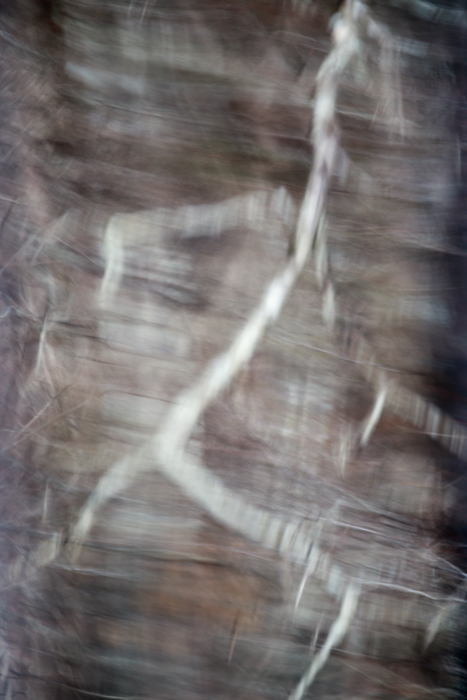
I was shooting photos from my deck with my 600mm lens when I noticed reflections in the windows of the wood behind the house.  To my eye the reflections were clear and intriguingly patterned, but the windows were just inside the minimum focal distance for that lens. When I downloaded the images, I was quite surprised at the stick creature running through the wood that appeared in front of me as I had not seen that shape with my eye when capturing the image.  Though abstract and far from the crisp realistic images for which I usually strive, I found the result hauntingly beautiful.

Stick Creature-3685

Quite interestingly when I designed and built this house, I found  slab of granite that I thought was the most amazing piece of natural art.  It is 5′ x 8′, weighs 750 lbs, and hangs on the wall of my dining room.  I was attracted to this particular piece of stone because of the colours, the striking veining that made it a Rohrshach test, and the particular image I saw when I looked at it.

Granite-4057

The similarity to the reflected image is quite remarkable.  Chance; serendipity; my life is punctuated by aliens or woodland creatures?  No matter, I glad they are here for whatever reason and by whatever means.