
The Oral Presentation assignment has been published on Vimeo and is embedded below. The password is Falmouth.
Author: chasingthewildlife
Work in Progress Portfolio
My work in progress portfolio took quite a lot of editing and went through several incarnations before it came to its final version. I began working to compile the portfolio several weeks ago reviewing the hundreds of photos I took during the module; both those that were direct project work and those that were not. I undertook several side projects that included field trips to other places for wildlife photography, a commissioned project for a breeder of dressage horse, projects that were prompted by the curriculum, and projects related to organisations I support. I undertook experimentation particularly in macro and super macro work as a way of capturing the smaller inhabitants of Coul Links. I also began trying to become more comfortable photographing people as I have come to realise that my project work will ultimately require it.
The first iterations were organised around a conceptual framework that included looking at the land from a bird’s eye perspective, a human’s eye perspective and then a bug’s eye perspective. The idea was using a very broad views from above, flatter views from the ground and then very close up views of the world beneath my feet. I also tested a Powers of Ten type concept where I had photographed the same view with increasingly longer lenses and narrowing perspective intending again to ultimately get to the world beneath my feet since I had spent a fair amount of effort on the macro work during the term.
I had also continued my repeat photographic work at Coul Links throughout the term and there were discernible changes in the landscape, however, I was struggling with a way to condense a sizable amount of work over 4 months into something meaningful in 18 or fewer photos. So the second iterations attempted to show some of the landscape work intermixed with some of the normal wildlife and macro work. When I showed those compilations to tutors and peers, there was almost universal agreement in one form or another that the breadth of perspectives was not communicating a clear story or a consistent visual aesthetic.
Along the way late in the term, I tested a concept showing a golfer “playing” the proposed routing of the new course as it is today. I had the idea that I would desaturate those images to give a historical feel to them. That concept got both good and bad reviews and, in the end, I decided the desaturation was too heavy handed and essentially a trope that wasn’t setting the groundwork for my ultimate story. Tutorial comments and some additional research into social landscape photography that led me again to Dorothea Lange’s work revealed to me though that my project needed something more than just the natural history approach I had been taking. I realised that what was being argued and what was at stake for the future of Coul Links is about how people have and will interact with this land. That caused me to pour back through my aggregated work again and find those few photos where I had managed to incidentally capture people on the links. At this point I still had some wildlife photos in the mix.
My project is complex with a number of different elements that in the end could potentially comprise distinct independent stories, or could be combined in different ways to create one or several stories. However, all that complexity and diversity in the type of images I am capturing makes creating an interim portfolio that stands on its own thematically and aesthetically a challenge. I had to overcome the inclination to try to show it all, because I was ending up showing nothing. I had to let go of emotional attachments to my work and any pre-conceived notions about what type of genre(s) I fit in as a photographer. I had to begin looking at my work in a completely different way than I ever had prior to this course. Fortunately, the critical theory readings that seemed in many ways beyond my understanding during Positions and Practice when augmented by the many additional readings during this term had somehow begun to coalesce into something comprehensible and even useful. I was moving in the correct direction, but I still wasn’t there as I learned when reviewing drafts of my portfolio with tutors. While I had come closer on selection of work there was still a sense that it was not yet organised and displayed in a way that communicated effectively. My last one-to-one with Michelle left me utterly confused at first and feeling lost as to how to proceed. I was limited by the structure of my SquareSpace website that wouldn’t allow me to organise my photos in grids or groupings and I didn’t know at first how I was going to overcome that limitation. Ultimately, I found my way back to Abobe Spark as it allowed me the flexibility to create a layout that would allow me to communicate more effectively.
The final iteration integrated elements of the repeat photography with a twist, and was also intended to introduce the exploration of how people are interacting with the land. The twist was packaging work that looked at the same areas of the landscape but from different perspectives rather than the traditional repeat photography approach of identical perspectives, and which included photos made in different months. I did do the classic repeat photography work taking all the identical perspectives at different times, but chose not to show them that way. I also made a conscious decision to not include wildlife in this portfolio. I have shown the quality of that work in past submissions and was able to show examples of what I had done in the Oral Presentation. It was time to do something different. I hoped that approaching the portfolio this way would begin to show how the landscape changes in subtle ways throughout the year, would illustrate my various methods of image production while at the same time carrying an aesthetic that was cohesive and introduce ideas about how I might move forward in showing how various people use this land now and might use it in the future.
My portfolio can be found at the following link:
Week 11 – Breakthrough
During last week’s webinar with Cemre Yesil, she noted how the photos I showed her as part of my WIP portfolio that included people were more powerful. Now several days later after working through the selections for my portfolio and exhibitions and trying to find the story, it suddenly occurred to me that I may have been approaching this story from the wrong angle entirely. I started this journey thinking of the Coul Links project as principally a natural history project and that I would observe and document how the landscape and its inhabitants changed due to natural and in response to anthropogenic changes. And there is some merit in that yet, but that approach doesn’t speak to the root of the controversy that has dogged the site and the planning application for development over the course of the last three years.
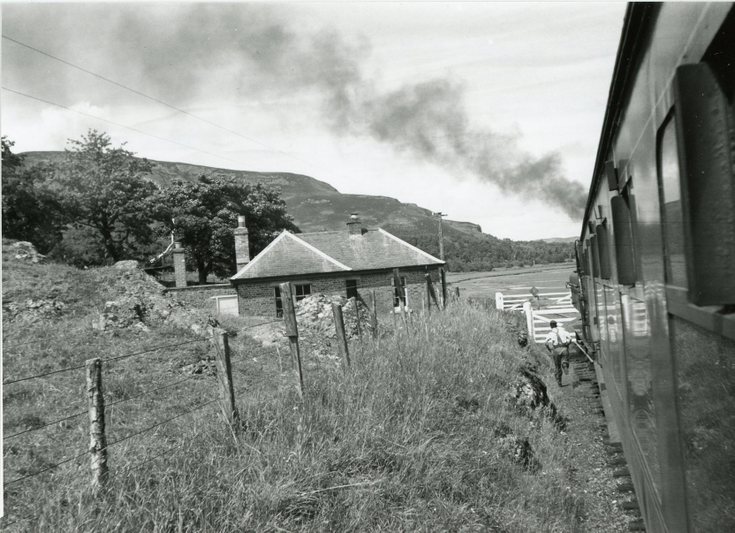
As I thought about Cemre’s comments and looked at hundreds of photos, I realised the crux of the controversy is a difference in opinion about how the land should be used and by whom it should be used. This land has seen many uses over time. It was home to the Dornoch Light Railway for many years.
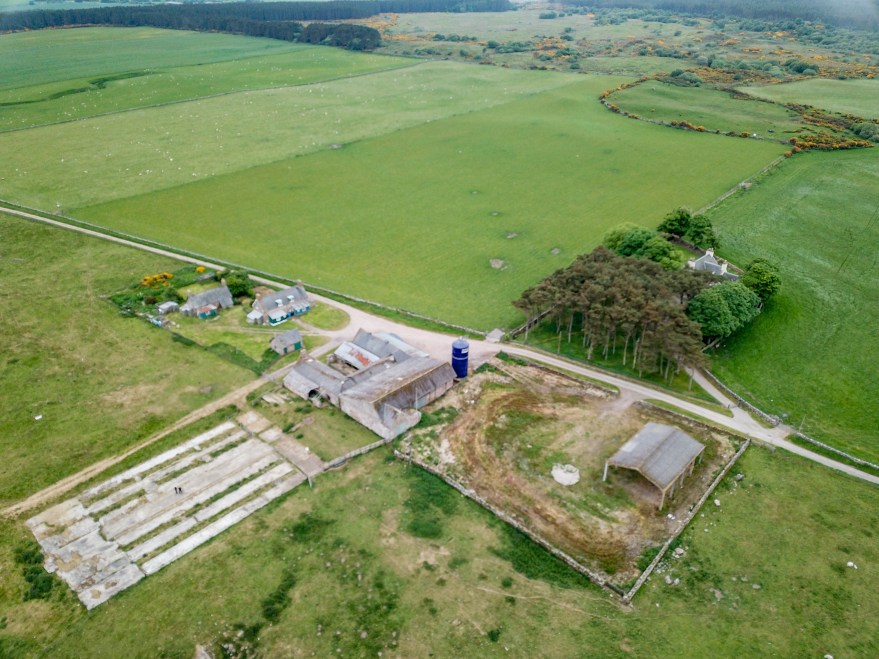
Until 1989 it was a fully working farm when the displenishment sale relegated it to grazing land and haylage harvest.
It had a tree plantation which was harvested many years ago and the remnants of which can still be seen today.

It has been used by the landowners to hunt deer and waterfowl, though under the proposed development that will cease. The abandoned light railway bed is a walking path, and myraid path and trails from the village of Embo are frequented by walkers and their dogs. The beach ahead of the foredune is spectacular and draws locals and the many visitors who stay in the caravan park just to the south of Coul Links. The northern end of the property along the Loch Fleet estuary is home to tens of thousands of wintering birds.
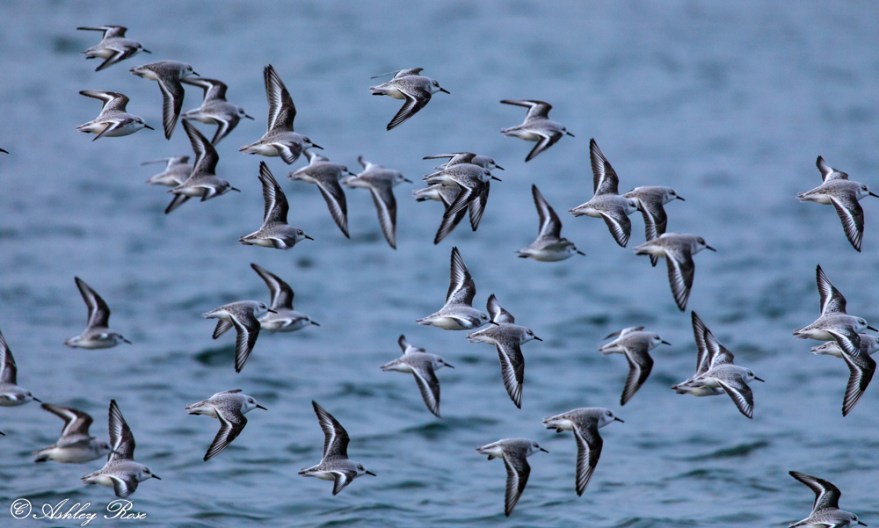
So it is clear that this land has seen many uses over the centuries. Now there are many who would see the landscape altered slightly to allow yet another use as a golf course without denying the current uses, except for the hunting. The developers intend to preserve and enhance access for walkers and nature enthusiasts. The wintering bird populations will not be impacted as the golf course will close in October and not reopen until April each year and the majority of the birds are not actually on Coul Links proper in any case. Grazing will continue. The opposition groups however fear the introduction of a golf course on a small fraction of the total acreage will irreparably harm the site and I believe they are also afraid non-golfers will be excluded from the site as they have been at the Trump golf course in Aberdeenshire.

So, though I am somewhat surprised to admit, the heart of this story is actually about people and their interactions with this land. Yes the landscape will change with the seasons, the weather, climate change and inevitably with some form of man-made change. Wildlife, flora and fauna, will be affected by natural and anthropogenic change in any case and it is only a matter of degree as to when and how much, but they will adapt in almost all cases. Natural succession is evident across the landscape and land ungrazed quickly returns to wild and overgrown state. There will still be those interested in seeing the bird populations that will use the land. At the end of the day though, who uses it and how will it be used in the future is where the broader interest in the story lies.
So while it is a bit too late to alter what I have done for this module, I will be shifting my approach somewhat going forward to capture more of the aspects of how people are currently using the land and how that changes along with the landscape in the future.
Week 10 – Finalising Exhibitions
There was a bit of wrinkle in the plans for the local exhibition at Grace of Dornoch Deli and Cafe and we have had to delay the opening one week. There was a misunderstanding on the original dates and there was a conflict with another artist to whom the owner had committed.
So no real bother. All the work for the exhibit is mounted and ready to hang. I will be allocated space in three principal areas as previously discussed and it will show along with the other artist’s work that will be installed in the prior week. The owner’s were very keen on my work when I first approached them and even more so when I brought in the mounted work that would comprise the exhibit. We are planning an opening reception on 27 August and the exhibit will run for at least a week, though the owners have expressed and interest in having some of my work on a longer term basis.
Social media announcements will go out shortly on the venue’s Facebook page as well as mine. Word of mouth has also been generating some excitement and I believe the opening and exhibit will be well attended.
My selections and preparation for the Landings online exhibition were completed just in the nick of time as it went live a few days earlier than I had expected. I found myself wrestling with different ways to order and organise the photos I selected. Originally I had some of the macro work in the selection for both the Landings exhibition and my WIP portfolio, but last week’s webinar with Cemre and peers strongly suggested that those photos detracted from the rest of the work I selected and was not consistent enough in style to hang together with the rest of the work. Though I spent a good bit of time this term on the macro work I understood the comments and took them to heart. It is still solid work and can stand alone, but it didn’t mix well with the bigger landscape and wildlife work.
It is challenging to step back from one’s work and look at it with a dispassionate eye and think about how differently viewers will see the work, and how the selections are both meant to be read and likely to be read by viewers. I found that the story I hope to tell is both early in its evolution and not fully formed in my own mind. And at the same time it is a big and complicated story that is not necessarily easy to tell. “A lot of us go about our work and feel like we have nothing to show at the end of the day. But whatever the nature of your work, there is an art to what you do, and there are people who would be interested in that art, if only you presented it to them in the right way. In fact, sharing your process might actually be most valuable if the products of your work aren’t easily shared, if you’re still in the apprentice stage of your work, if you can’t just slap up a portfolio and call it a day, or if your process doesn’t necessarily lead to tangible finished products.” (Kleon, 2014)
I believe that not trying to determine the outcome before sufficient data are collected can be in part attributed to my training in science and perhaps personal proclivity, but that adds to the challenge of trying to make a narrative hang together at this point. I hope I have chosen well enough to give some sense of scale, process and context to the beginning of the story and at least pique the interests of people enough to cause them to look forward as I do to seeing the remainder of the story unfold over time.
I am fortunate to have talented peers in this course and they have been very helpful in the process of choosing what and in what order to show my work. Despite taking photographs for over 50 years I rarely showed my work and never before exhibited or published until beginning this course. The feedback from peers and tutors has been invaluable in helping me to begin to understand how others see, often differently, than I do. I have much to learn yet about editing, curating and presenting my work, but it is a path down which I have begun to journey and one I look forward to continuing.
I have a third opportunity coming up as I have been asked by the local chapter of the Scottish Women’s Institute to come speak and display my work on 18 September. They are expecting me to speak for about 45 minutes so there will need to be some extensive curation to fill that amount of time. That push will have to wait until after the assignments for this term are complete.
Kleon, A. (2014). Show Your Work: 10 Ways to Share Your Creativity and Get Discovered. New York: Workman Publishing Company.
Week 10 – Overall Reflections on the Surfaces and Strategies Module and Critical Analysis of My Progress in the MA
To my few devoted readers, I apologize in advance for the length of this post. It is one I have been contemplating and working on for some time now, and it reflects the integration of much of my research to date and how that research has influenced my thinking about my practice. It also is intended to provide context to my Work in Progress portfolio and the choices I have made and additional background and context for my Oral Presentation.
When I began the MA programme, I would have characterised (had I even been aware of her writings) in “Sontagian” terms as indexical (Sontag, 1977), and that I was most concerned with depicting reality. As I have progressed through the first two modules of the MA, I have come to realise my work is only my interpretation of reality within the limitations of the camera program’s ability to capture a moment is time and space, and my rendering of that image in post-processing.
In Ways of Seeing, (Berger, 1972) Berger writes, “Photographs are not…a mechanical record. Every time we look at a photograph, we are aware, …of the photographer selecting that sight from an infinity of other possible sights.” In Towards a Philosophy of Photography (Flusser, 2000), Flusser writes “The possibilities in the camera’s program are practically inexhaustible…The imagination of the camera is greater than that of every single photographer and that of all the photographers put together: This is precisely the challenge to the photographer…pursuit of the informative, improbable images that have not been seen before.” This is indeed a daunting challenge particularly in light of the billions of photographs being taken every day around the world and the ubiquitous distribution systems enabled by the internet.
As a photographer, I and my practise are evolving, but I am not yet evolved and mature as a practitioner. In Steal Like an Artist (Kleon, 2012) Austin Kleon posits “Nobody is born with a style or voice…We learn by copying. We are talking about practice here, not plagiarism – plagiarism is trying to pass someone else’s work off as your own. Copying is about reverse engineering…First, you have to figure out who to copy. Second you have to figure out what to copy. Who to copy is easy. You copy your heroes…What to copy is trickier. Don’t just steal the style, steal the thinking behind the style. You don’t want to look like your heroes, you want to see like your heroes.” I have endeavoured to embrace this philosophy.
This term has afforded me opportunities to explore new photographic techniques, different approaches in post-processing, and new ways to display my works from books, zines, social media, and physical exhibitions in addition to enhancing my on-line galleries. I have also stretched myself by photographing subjects out of my comfort zone in some cases and in others subjects I had not photographed before within the genre I typically work. I have also begun to appreciate that what happens to be in front of my lens sometimes contains elements that detract from the real intent behind the photograph. Whereas in the past I might have left something in the photo because it was really there, I am now making efforts to crop more artfully or remove specific distractors from my photos in post-processing. Sometimes, less is more.
The Ed Ruscha challenge proved to be inspiring, motivating and confidence building. It required conceptual development, planning, execution, editing and curation and resulted in a published book, 19 Sutherland Bridges, of which I am proud, and which sits for sale in the Bookshop below the flat in which I live. It was the first time in all my years of photography my work was contextualized in a way that resulted in a tangible, physical product; and it was thrilling.
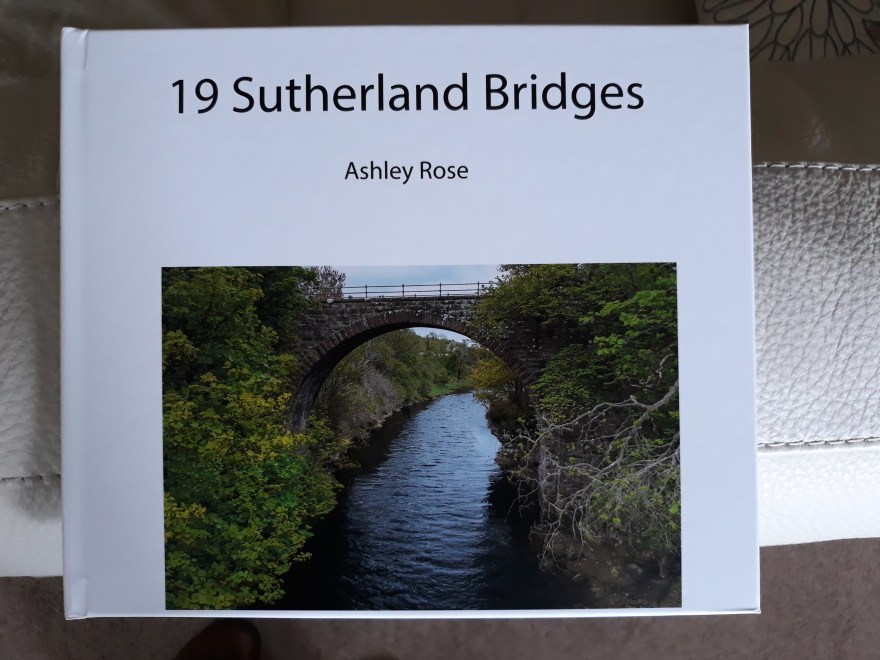
Creating and publishing 19 Sutherland Bridges had a significant impact on my thinking going forward causing me to be more purposeful about when, where and what I photograph, and to plan how I want to use what I capture.
I used this term also to learn and experiment with additional methods of capture and post-processing, and with added subjects sets than had been my norm. While using and investigating macro photography and how it could potentially complement and add additional dimension to my project, I encountered the work of John Hallmen and the technique of focus stacking. I was stunned by the detail and clarity he was able to achieve which far and away beyond anything that is possible with mere depth of field management and I felt compelled to learn more about his process.
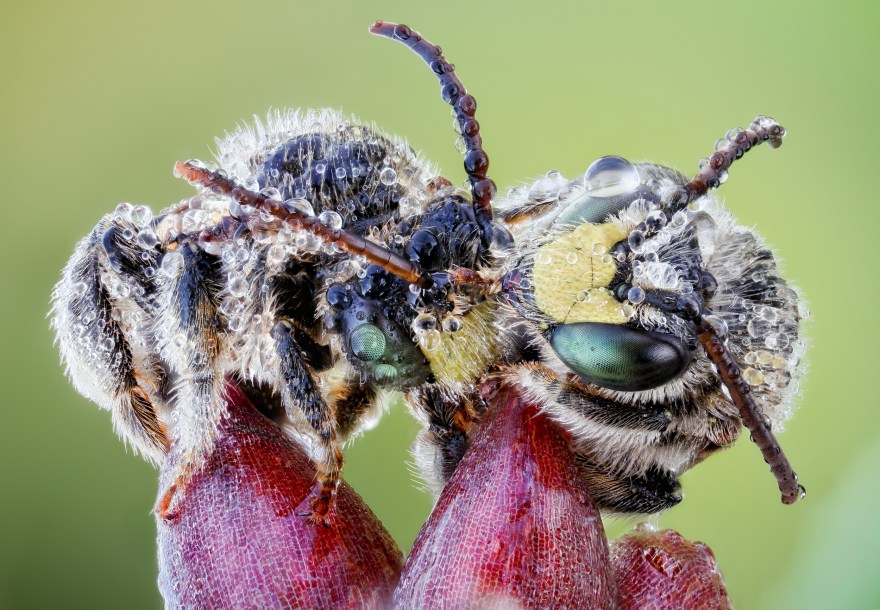
Photo: John Hallmen
It is quite exacting and difficult to achieve in situ if the environmental conditions are anything but quite still air and reasonably stationary subject because between 20 and 50 frames with minute focal plane changes are required. I was able to manage a few good results from the field, but I had even better success bring the subjects into a more controlled environment.

Given the subtleties of the natural changes in the short time in which I have been photographing Coul Links, I was looking for away to represent a sense of time in the place that could be contrasted with the anthropogenic changes that are anticipated. In addition to the “standard” natural history repeat photography techniques I have been employing and having the foreknowledge of a significant event to come, I sought to also approach the project from a Before and After Photography (Bear and Albers, 2017) perspective. I captured images along the planned routing of the golf course with and without a model dressed as and using equipment from 100 years ago. I then desaturated the images to imply a sense of age to the photos. Richard Barnes in his Civil War series took contemporaneous photos of Civil War re-enactments in monochrome and deformed the edges of the negatives to create a sense the photos were taken during the war and to achieve a Matthew Brady type aesthetic. Barnes work, however, is often cheekily betrayed by the presence of anachronisms such as power pylons or observers of the re-enactments in clearly modern attire.
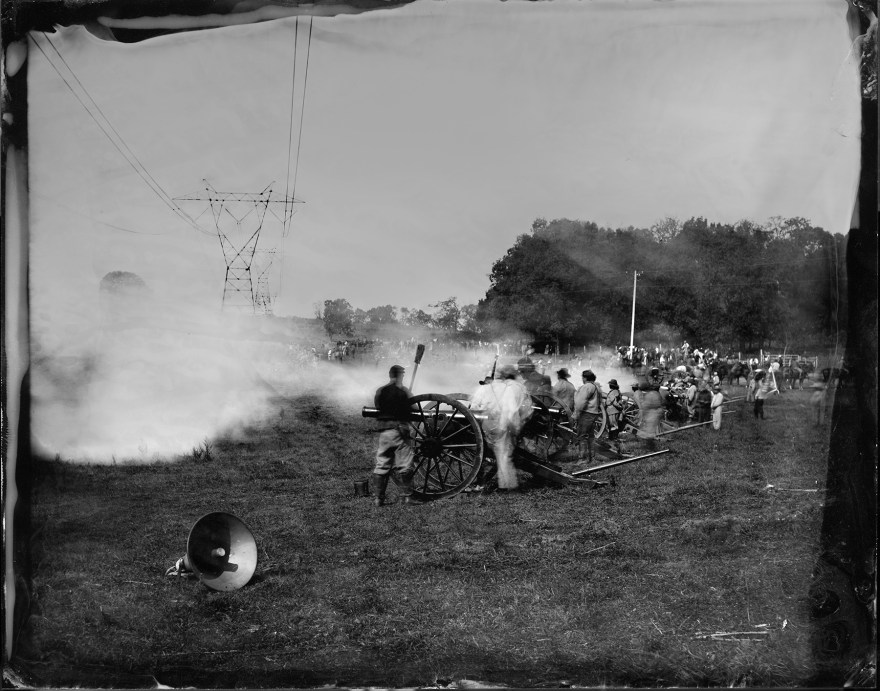
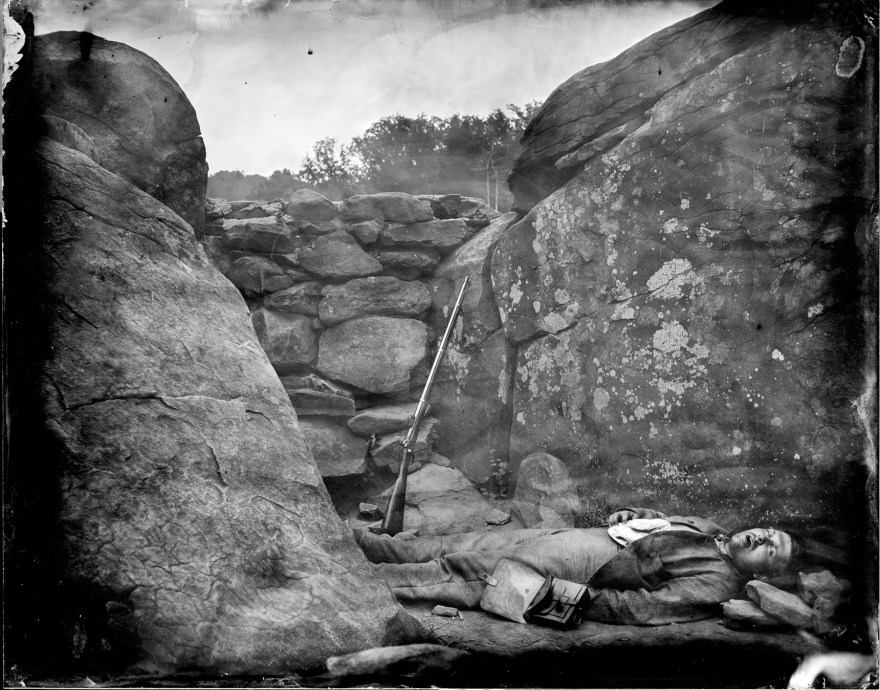
Photos: Richard Barnes – Civil War

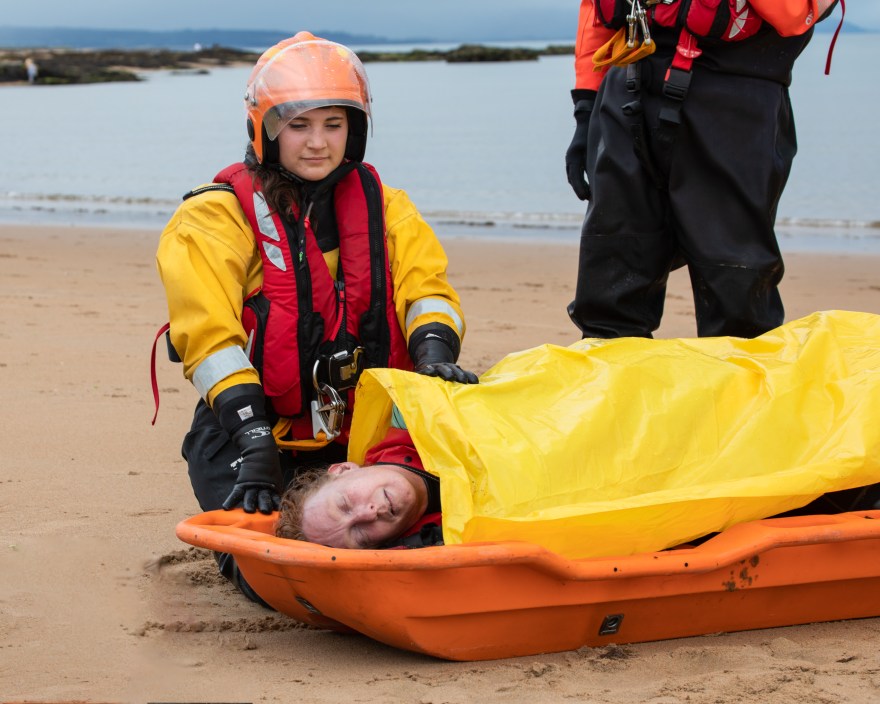
In anticipation of the possibility that my Coul Links story might not be able to be told without the inclusion of the human elements of the story, I took opportunities to do some environmental portraits and documentary photography. The inshore lifeboat crew on which I serve proved to be an excellent subject, because I am also responsible for managing most of the team’s social media presence, internet fund raising and for photographs provided to print publications for news reporting and promotion. Photographing people, something with which I have always been a bit uncomfortable, and publishing to social media and newspapers has been a good, practise expanding experience and shown me how much reach and influence social media can have on the organisation.
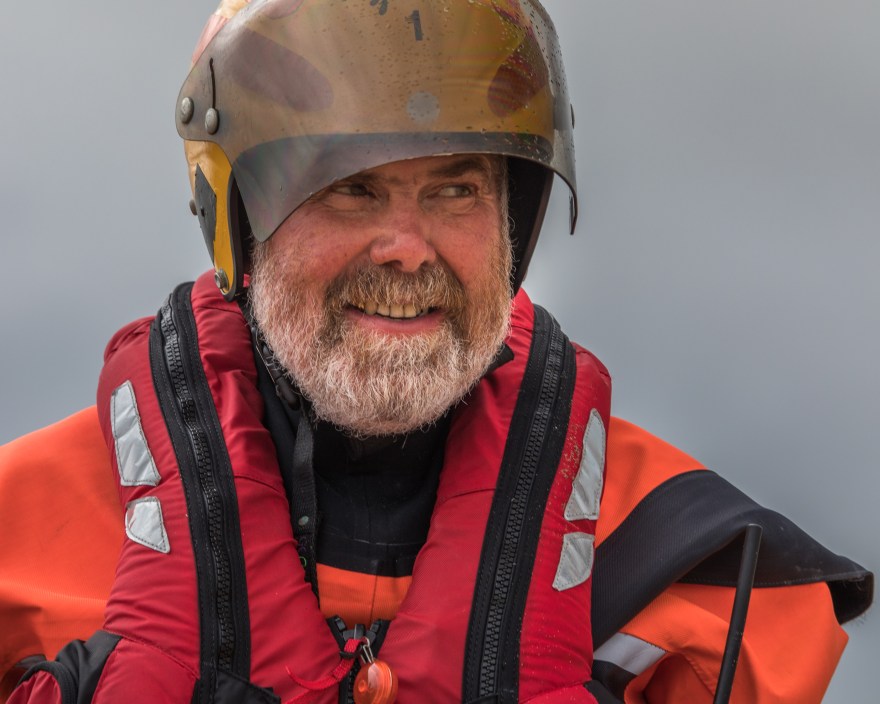

In these genres, I am actually inspired by two of my peers; Danny North and Mick Yates. Danny’s portraiture has a soul penetrating quality and yet conveys a deep and abiding empathy for his subjects. There is never a hint of exploitation, but rather a real sense of emotional connection and care for his subjects and their feelings. I find much of Danny’s non-commissioned work very intimate and intensely personal.
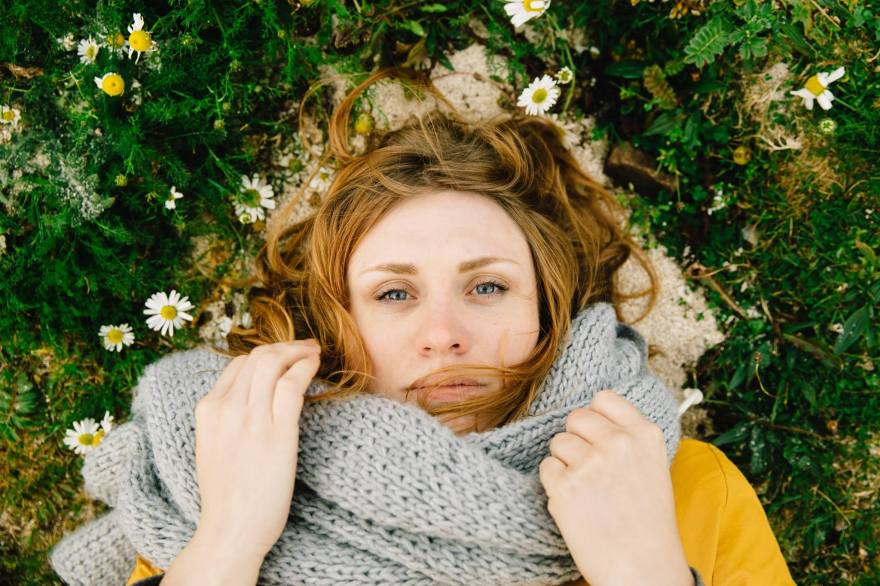
Photo: Danny North – Jenna
Mick Yates work also shows great respect for his subjects but conveys something more in a sense of time and place than soul penetrating. There is often a slight distance and detachment that puts the person and place in perspective giving it more of a documentary and formal character than an emotional and very personal one.
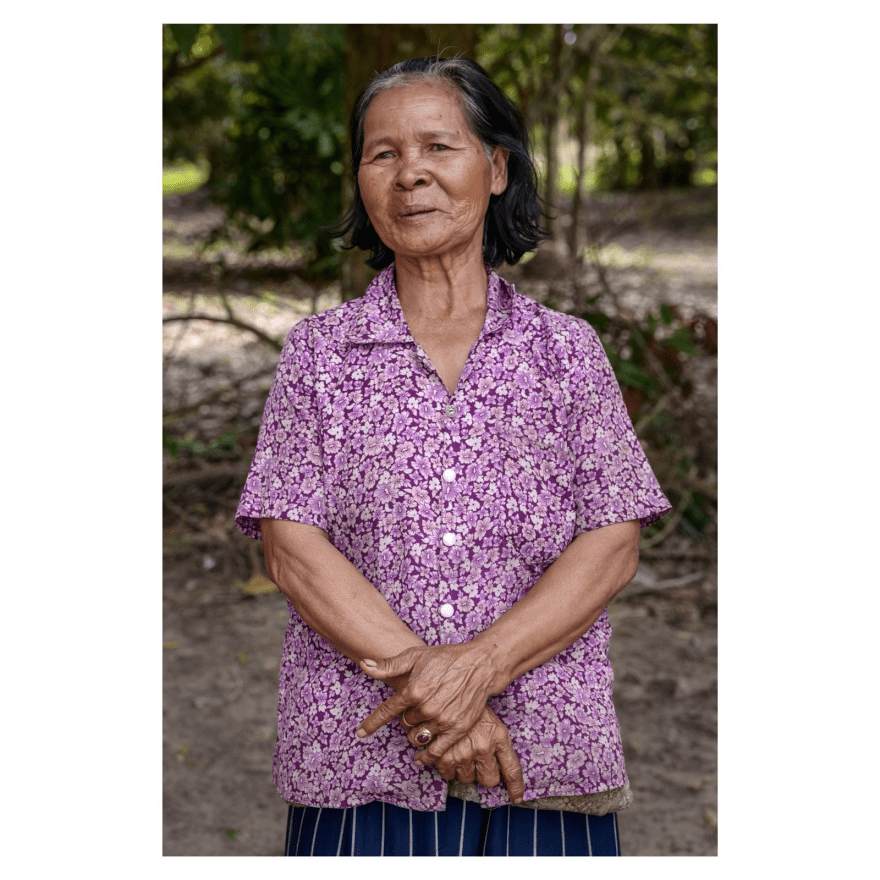
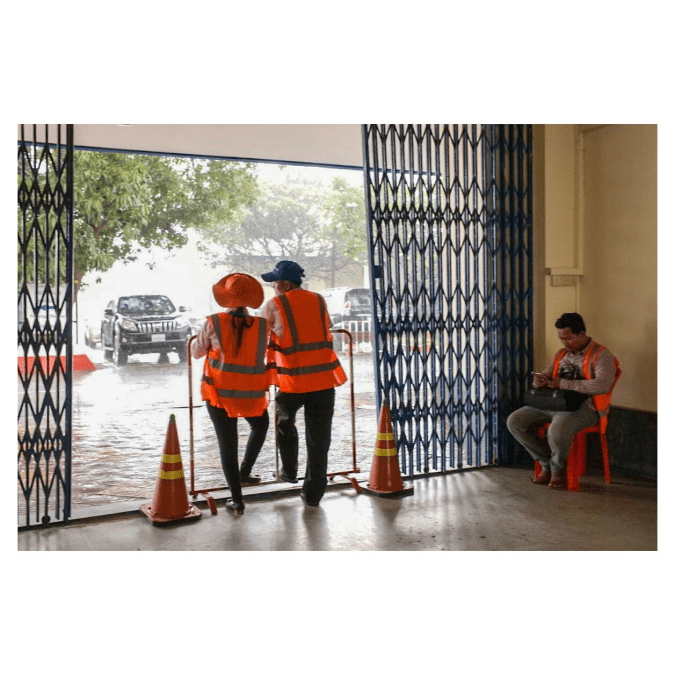
Photos: Mick Yates – Cambodia
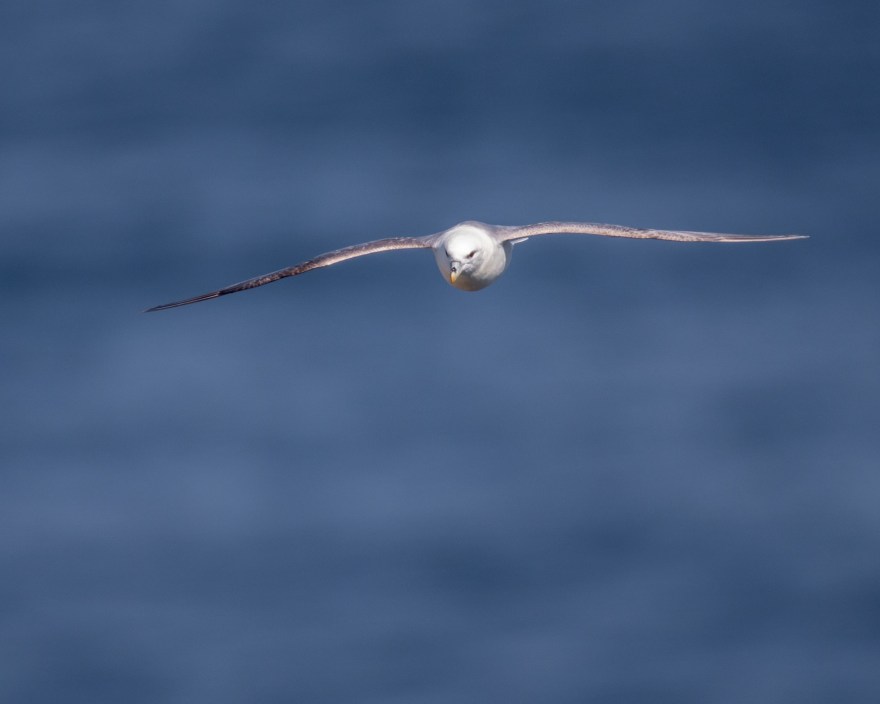
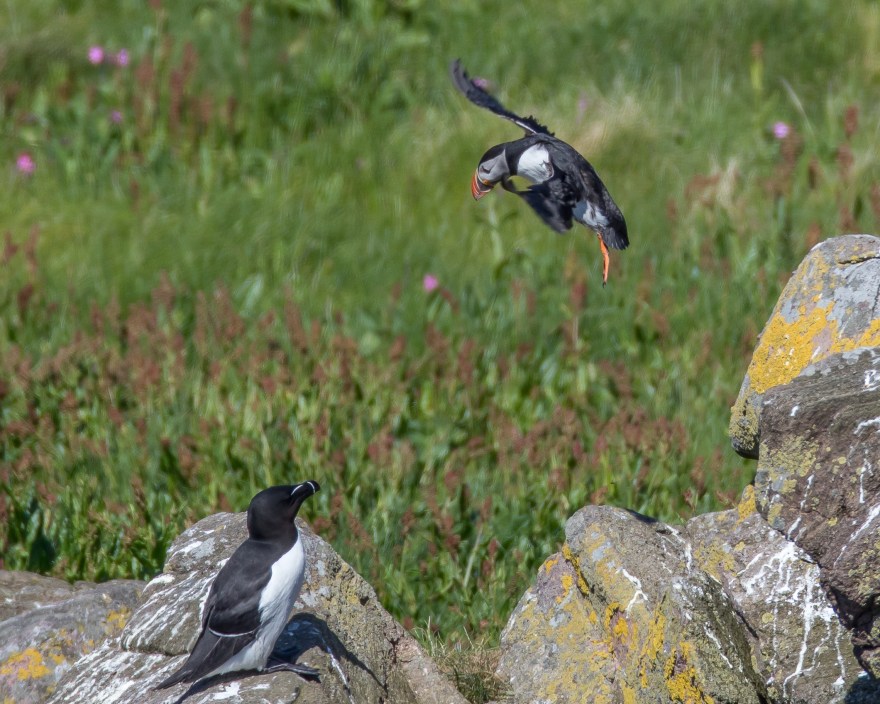
Lastly, I continued working to improve and refine my wildlife photography skills. I went even bigger, working with focal lengths up to 840mm, which presents challenges with dynamic subjects, but the results when I got it right are extraordinary and I was able to record some very special images. It gave me the reach necessary to get the kind of detail on subjects that were often quite far away, but to which I could not physically approach any closer.
I encountered some technical challenges in my aerial repeat photography work which I have not fully resolved. I have been very successful in using a mission management application that allows me to fly the exact route and take photographs of the Coul Links from identical perspectives each time I fly. However, since it is a third-party application, it appears to not be as good at controlling the camera as the manufacturer’s proprietary application. The resolution is adequate to detect change, but it is not at the standard I would like to show detail. The proprietary application cannot do the multi-waypoint mission profile around the perimeter of the nearly 800-acre plot of land, so I am faced with something of a dilemma to resolve. I am continuing to explore means of improving resolution in the third-party application.
Barnes, R. (n.d.). Civil War — Richard Barnes. Retrieved August 9, 2018, from http://www.richardbarnes.net/civil-war-1/
Kleon, A. (2012). Steal Like an Artist: 10 Things Nobody Told You about Being Creative. Steal Like an Artist (Vol. 53). New York: Workman Publishing Company. https://doi.org/10.1017/CBO9781107415324.004
Flusser, V. (1983). Towards a philosophy of photography. English. London: Reaktion Books Ltd. https://doi.org/10.1016/S0031-9406(10)62747-2
John Hallmén. (n.d.). Retrieved July 10, 2018, from http://www.johnhallmen.se/2016/12/8/emus-hirtus-1
Sontag, S. (1977). On Photography. Penguin Books. https://doi.org/10.1007/s13398-014-0173-7.2
Berger, J. (1972). Ways of Seeing. Ways of Seeing. London: Penguin Books Ltd.
Bear, J., & Albers, K. P. (2017). Before-and-After Photography; Histories and Contexts (1st ed.). London; New York: Bloomsbury Academic.
Webb, R., Boyer, D., & Turner, R. (2010). Repeat Photography: Methods and Applications in the Natural Sciences. Washington, DC: Island Press.
Week 9 – Preparation for Exhibition
A considerable amount of my time this week was spent arranging for and making decisions about what photographs to include in my local exhibition. Of course, that was tied closely to which photographs I would be including in my Work in Progress portfolio, my Oral Presentation and the Landings on-line exhibition. I was successful in obtaining space in a local cafe/ deli which is also about to begin exhibiting another local artist’s work. Her artwork is Scottish themed and tends toward the abstract, but her subject matter and palette are somewhat similar to the work I proposed to exhibit. The owner’s of Grace Deli were quite excited by my work and were also keen on keeping some on after the exhibition period. My work would be allocated wall space in and around that of the other artist in three main areas. The idea behind my exhibition is Coul Links: From Above, Beneath My Feet and In Between thematically breaks nicely into the three areas. Final placement and choice will depend on the other artist’s installation which is supposed to happen later this week and I have selected a mix of A3 and A4 sized prints to allow for some flexibility in final placement.
I met with a local framer who will be mounting my work on backing with simple white matting. We decided simplicity and uniformity for this short exhibition was prudent. Works to be left after the exhibition for sale will be framed and mounted with matting that is specifically appropriate to the individual piece.
With quite a lot of photographs from which to choose, I had to consider several aspects.
- How much space would I have?
- How would that space and the things around it affect the perception and context of my work?
- What would appeal to the owner’s and clients of the café given there is at present a high level of tourist trade as well as local clientele, and how can the presence of my work be beneficial to the owners?
- Since the Coul Links story is yet largely unwritten, which pieces of my work would indicate the direction it is heading and showcase the quality of my work to date?
- What could I get done in the short amount of time using only local and personal resources without losing sight of the other requirements of this module that must be completed by 24 August?
I hope I have chosen well, but that is what this experience will be about: going through the process, evaluating the outcomes and being better prepared for the next time. This is relatively unplowed ground for me as it is only since beginning this course that I have been showing my work and contextualizing it in various ways. I don’t expect this one to be perfect and I do expect to learn from it. I also hope to have a bit of fun along the way.
The exhibition will begin with an opening reception on the evening of 16 August and run from 17 to 24 August at the Grace Deli in High Street, Dornoch. I extend my gratitude to the the owner’s, Donald and Lorraine Goldsmith, for their support and generosity in offering their establishment to me.
Week 9 – Guest Lecture with Welby Ings
I have attended or listened to the majority of the guest lectures during the MA to date and I have to say I found Welby’s lecture to be the most relevant, informative and practically useful one to date. His discourse on methodology and methods backed up with tangible examples in his work made for a very well spent hour that helped me make more sense of what I am doing and how to proceed with further enquiry. Some of my notes follow.
What is a thesis?
- To position an idea.
- A practice led thesis could be non-written work.
- It cannot be objective because we are central to it and it is therefore subjective
Method vs Methodology
- Research Methodology
- Must show basis for moving knowledge beyond current state of your practice
- Task completion vs. real research
- Quality of research
- Research Methods are merely your tools while methodology is the toolbox and how you use the tools
- Practice led research is qualitative (action) research
- Histiography
- Narrative inquiry
- Ethnography
- Auto-Enthnography
- Heuristic inquiry
- Discover/ find using accrued knowledge to find your way through uncharted territory through trial and error. Relies on tacit knowledge. *Michael Polanyi, The Tacit Dimension (1967) and work by Clark Moustakas
- Methods of heuristic inquiry
- Observation and notation
- Experimentation in materials and processes
- Reflection in and on action
- Critical feedback
- Organizational and analytical matrices from the social sciences
- Must show basis for moving knowledge beyond current state of your practice
In the end he encouraged us each to find the inherent research potential in ourselves. It was an inspiring lecture and one I am very pleased I did not miss.
Week 8 – Reflections
This week was given to more experimentation and to finalising a venue for my exhibition in August. While I feel strongly that the longer-term story based on my project is on solid footing and will be able to be told, it will take some time to get there. So, I have been trying to find ways to make work in the interim that is more contemporaneously interesting as well as being a potential element in the ultimate story of Coul Links.
I also continued my reading after finishing Flusser’s Towards a Philosophy of Photography with two short books by Austin Kleon, Steal Like an Artist and Show Your Work, and I am reading Berger’s Ways of Seeing. The more critical theory I read it seems that everyone has their own view on the topic and there isn’t any universality of thought. Nonetheless, I am finding these reading somewhat thought provoking and they are providing me with a different vocabulary for thinking about and discussing my work.
Case in point, I asked two tutors for thoughts on some of the experimental work I had done this week. While both were encouraging and supportive of my efforts to push myself, I got diametrically opposed opinions about the work itself and which of the test cases was most interesting and effective. Fortunately, my own thoughts aligned reasonably well with one of the tutors. On a related note, after a few weeks of working with tutors in Surfaces and Strategies I find myself looking at my photos during post processing wondering what I can take out of them. While some of that can be done with cropping, some of it requires me to use Photoshop and I am seeing my skills and confidence with that tool improving as well, though there is still much room for improvement.
I revisited Sergey Larenkov’s work this week and was directed towards work by Richard Barnes in which he photographed Civil War re-enactments, and work by Deborah Baker.
Nothing in what I have done or read is changing my core methodology with respect to my project, but I believe aspects of the macro work I have been testing and the experiments this week with a model “playing” the course routing in its current natural state and repeat photographing the same perspectives when the new course is finished.
I am working somewhat in parallel in curating my WIP Portfolio, my Landings exhibition, my local exhibition(s) and a September one day speaking engagement where I have been asked to show my work. I need to get this decided quite soon for the exhibitions so I can get on to the elements of this term that are graded. I have also been asked to leave some of my work on display for sale in the venue that will host my primary exhibit. It is an entirely new thing to think about how to value my work.
Richard Barnes: http://www.richardbarnes.net/projects/#/civil-war-1/
Deborah Baker: https://www.crafts.org.uk/Makers-Directory/Baker,-Deborah.aspx
Berger, J. (1972). Ways of Seeing. London: Penguin Books Ltd.
Flusser, V. (1983). Towards a philosophy of photography. English. London: Reaktion Books Ltd.
Kleon, A. (2012). Steal Like an Artist: 10 Things Nobody Told You about Being Creative. New York: Workman Publishing Company.
Kleon, A. (2014). Show Your Work: 10 Ways to Share Your Creativity and Get Discovered. New York: Workman Publishing Company.
Week 8 – Pushing Boundaries
After reading Vilem Flusser’s Towards a Philosophy of Photography and considering many of the comments from my tutor about my work being somewhat predictable and expected, I have been pushing myself to find photographs that have not been taken and that are unexpected, and to find my own unique voice as a photographer.
Since my entire project was fundamentally “predictable” in that it was focused on repeat photography and wildlife photography, two areas where it is exceedingly difficult to be particularly unique, I thought I might have to consider ways to be more creative in my approach. One of the interesting aspects about the planned golf course at Coul Links is that it is already largely there and while different grasses will be planted in specific areas, the topography of the land will not change dramatically. The teeing grounds, bunkers and greens along with most of the fairway contouring have been formed by nature over centuries. In fact it is entirely possible that people have already played golf on this links land just as they have been doing on the Dornoch Links 3 miles to the south for over 400 years. What if the ghosts of golfers past are lurking and just waiting for their links to re-emerge and be again uncovered from the overgrowth that has occurred in recent decades?
In a radical departure from my normal “indexical” (Sontag, 1977) and ontological approach to my work, I wondered “What if a ghost of a golfer were wandering this ground today along the proposed routing of the new course?” An idea for a variation on repeat photography formed in my mind; “Could I photograph a golfer in traditional garb with hickory clubs of 100 years ago on the Coul Links proposed routing today, before any changes are made and then come back after the changes are made to take the same perspective with a golfer in contemporary kit?”
In this first photograph I desaturated the colour about 70% to give the photo a feeling of being in the past.
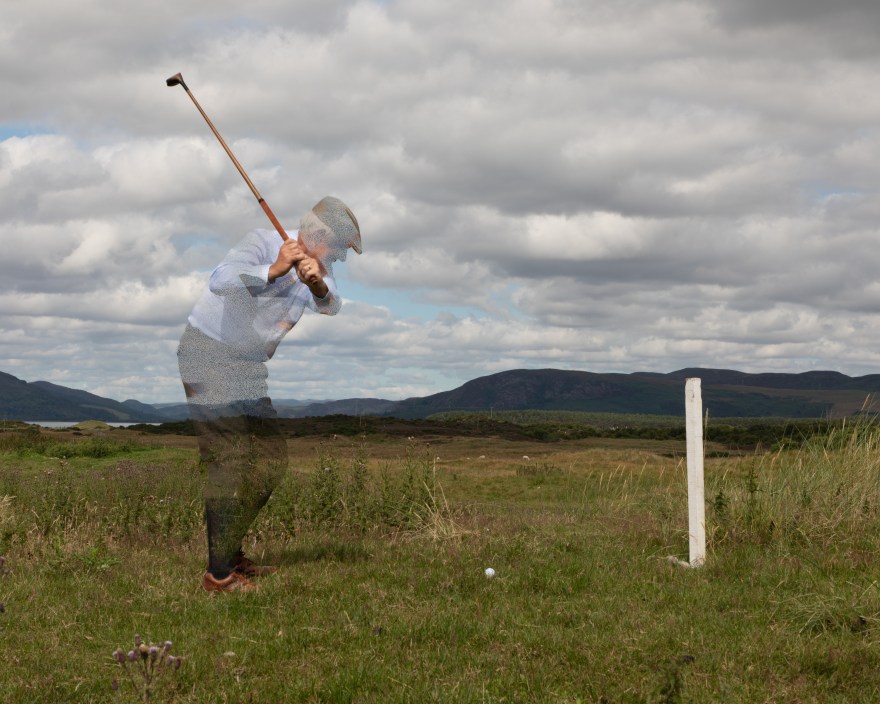
In this and the following photo, I left the colour levels as shot and dissolved portions of the golfer’s image to create a ghost-like effect, but left the feet and hands in the present as if the ghost were enjoying walking and playing a game on once familiar ground.
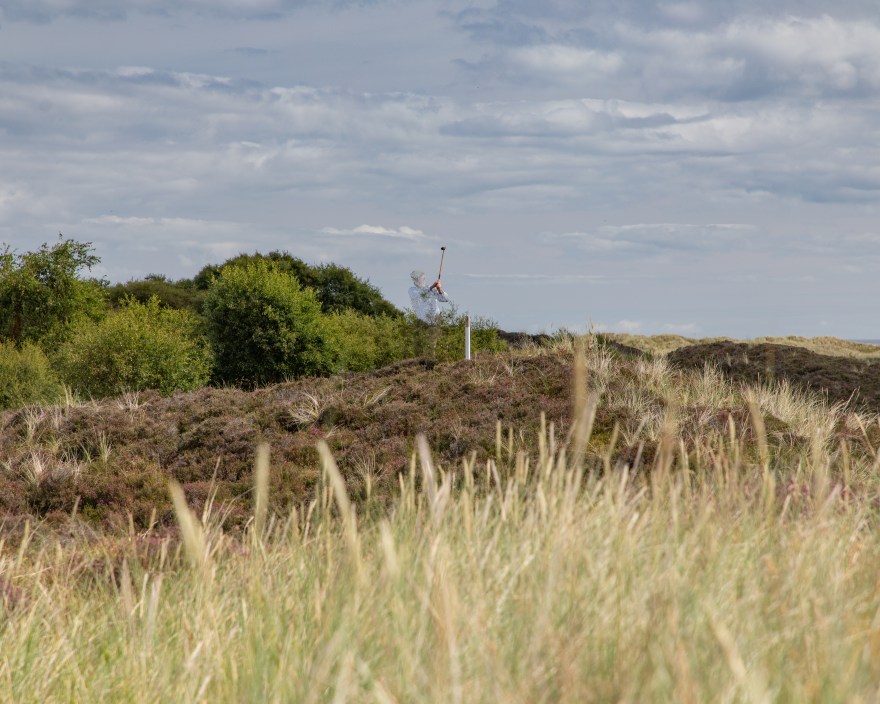
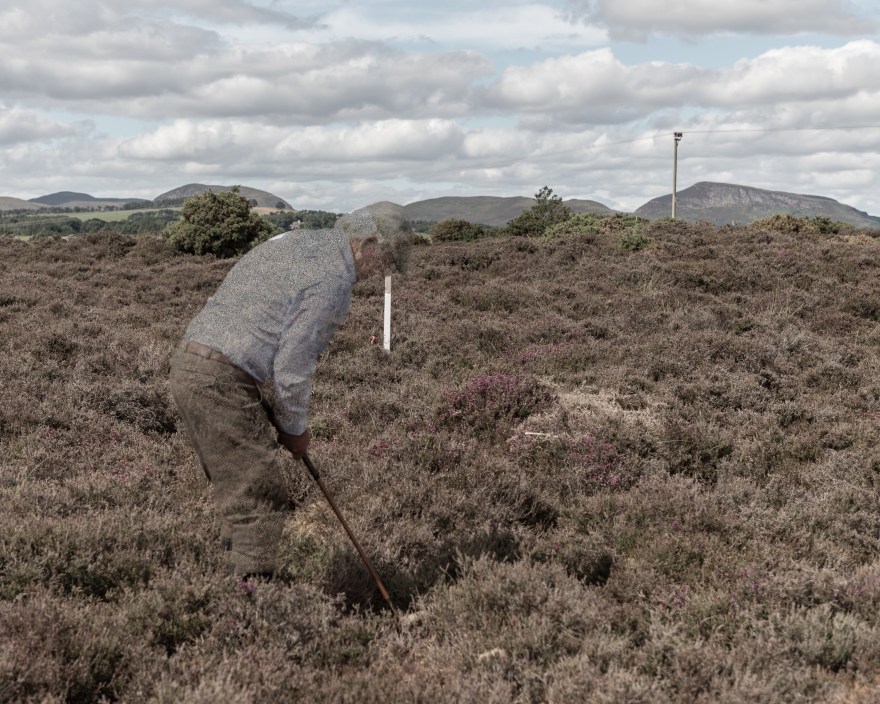
In this photo I used a combination of the dissolved golfer’s image, again keeping the hands and club in real time and desaturated the image slightly.
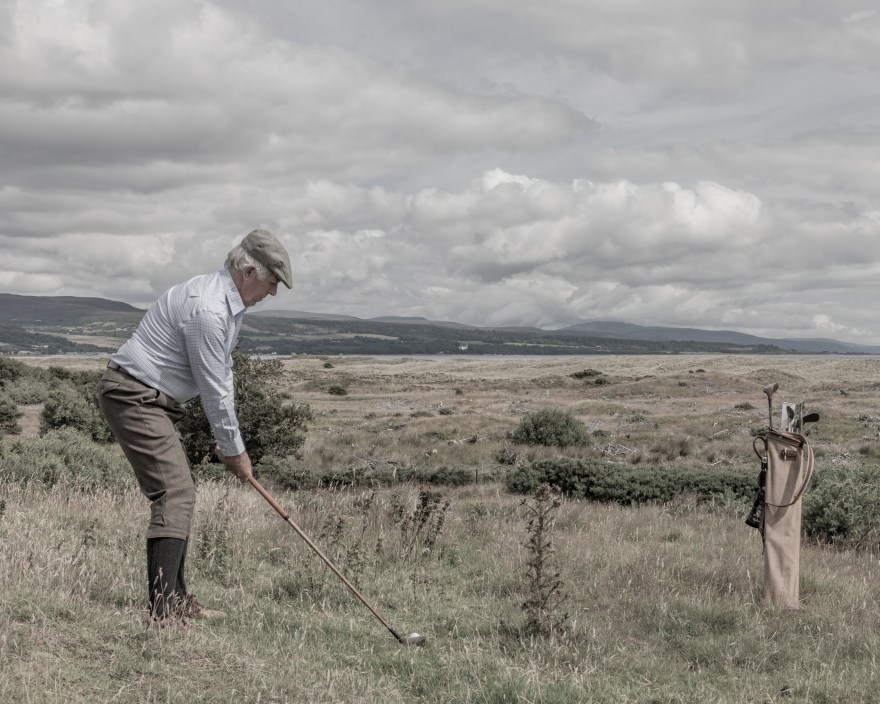
In this last image, I used the desaturation technique again to a slightly lesser degree to preserve a better feeling of the landscape while conveying the aesthetic of an older photograph.
I am not certain yet which of these techniques carries the most impact, though the surrealism of the dissolved images feels perhaps too much a departure from my practise. The desaturated images when paired with the future images on the completed course will convey a lovely sense of the Links (the sand based stretches of ground that serve as the link between the sea and the arable land beyond) then and now, as well as the links to the history of golf in Scotland which has been played on this type of land for more than 500 years. It is a departure from the strict natural history dimension my project has had, but I believe it has merit in the ability to show the landscape in a some way other than the “postcard” photograph and convey the story of the transformation of this place in a different way.
Flusser, V. (1983). Towards a philosophy of photography. English. London: Reaktion Books Ltd. https://doi.org/10.1016/S0031-9406(10)62747-2
Sontag, S. (1977). On Photography. Penguin Books. https://doi.org/10.1007/s13398-014-0173-7.2
Week 7 – Reflections
This week’s lessons revolved around publications and the various forms they might take with our work. We were tasked with creating a dummy book that I discussed and posted in my previous post. In my webinar with my tutor Michelle Sank, discussed the need for more thoughtful and perhaps non-traditional graphic design and provided me with some references to research. I was aware that given the limited time and the fact I started with the idea of doing a Zine exhibition guide and along the way morphed it into more of concept for a three part book that it lacked the necessary attention to graphic design. When it comes time to do a full blown book for my project I will have to seriously consider using a good graphic designer as it is an area in which I have limited experience.
Michelle asked to see a few of the photos of my most recent work in a larger size. I am continually amazed at how differently she sees photographs and how quickly she is able to identify elements to remove or crops that make the photo have stronger impact. I am a bit stuck in what I know, not because I want to be there or am uncomfortable elsewhere, but rather I am still finding my way through the labyrinth of photographic practice en route to discovering my own unique voice. Michelle was encouraging and felt she has seen a definitive shift forward in my recent work and I have been experimenting with both different techniques i my macro work and different moods in my my post processing. Some of the specific ideas she gave me about photos were almost startling to me and turned what I thought was the main focus of the photo on its head by telling me they were to predictable and in Flusser’s vernacular “familiar and redundant.” I made the changes she suggested re-cropping and or removing elements from the photographs. I have to admit those changes did indeed change the feeling and impact. I need to find a way to see more photobooks and acquire in my own mind what is familiar in the genres in which I work. How can my photos, again in Flusser’s words, become “informative, improbable images that have not been seen before?” I’ve work yet to do, but the journey is begun and I am moving forward.
Flusser, V. (1983). Towards a philosophy of photography. English. London: Reaktion Books Ltd. https://doi.org/10.1016/S0031-9406(10)62747-2
 Ashley Rose Photography Journal